Disclosure: This post contains affiliate links. I may earn a small commission at no extra cost to you if you purchase through these links.
My neighbor called this thing a “lawn tank” the first time he saw it. He’s not wrong.
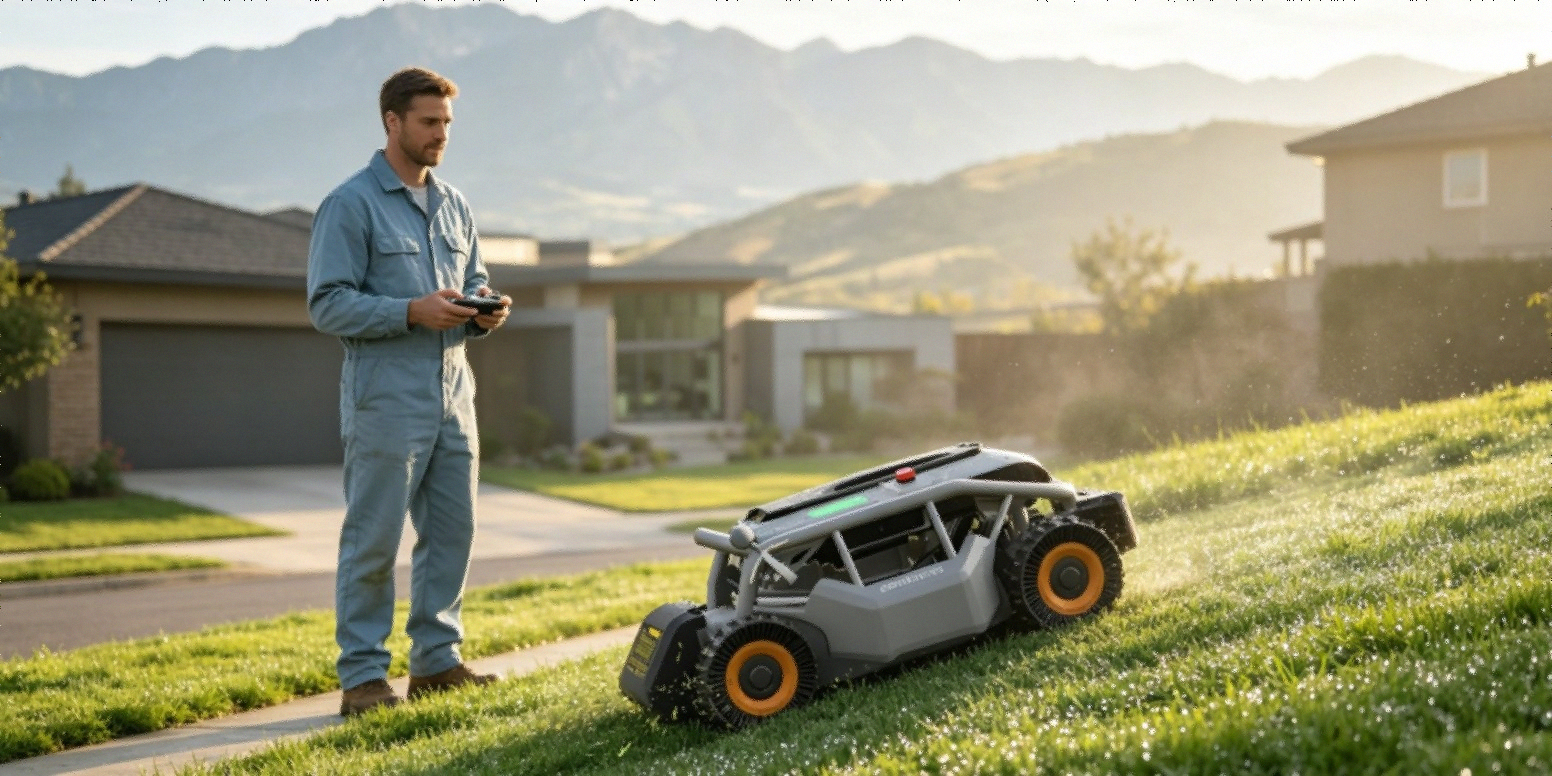
The Mowrator S1 4WD 18Ah isn’t a robot lawn mower in the traditional sense. It doesn’t wander your yard on a GPS boundary wire. It doesn’t map anything or schedule itself. What it does is more specific, and for the right yard, more useful — it lets you mow from a distance with a remote control, on terrain that would be genuinely dangerous to walk a mower across.
I spent time with this on a hilly half-acre property with a creek bank section that drops at roughly 35-40 degrees. Here’s what I found.
What the Mowrator S1 4WD Actually Is
This is a remote-controlled mower, not an autonomous one. That distinction matters more than it sounds.
Autonomous robot mowers like the ECOVACS Goat A2000 or Segway Navimow are built to mow your flat-to-moderate yard while you do something else entirely. Related Post: ECOVACS Goat A2000 LiDAR Pro Review Related Post: Segway Navimow X430 Review 2026
The Mowrator S1 solves a different problem — terrain too steep, hazardous, or irregular for autonomous navigation to even attempt. You stand at a safe distance — top of a hill, away from a slope edge, back from a pond bank — and drive it with a handheld remote. It does the physical work on ground where you’d be taking real risks walking behind a gas mower.
The 4WD 18Ah ECB model is the top configuration here: four-wheel drive, the larger 18Ah battery, and the ECB control board with the upgraded control modes. At $3,959 that’s a real purchase. Whether it’s the right one comes down entirely to what your yard actually looks like.
Key Specs: What 4WD and 18Ah Actually Mean
| Spec | Mowrator S1 4WD 18Ah ECB |
|---|---|
| Price | $3,959 |
| Drive System | 4WD, 1000W total |
| Blade Motor | 1985.6W peak |
| Max Blade Speed | 3200 RPM (adjustable) |
| Max Cutting Torque | 6 ft·lb |
| Slope Capability | 119% (50°) |
| Cutting Width | 21 inches |
| Cutting Height | 1.5–4.3 inches (5 positions) |
| Battery | 56V 18Ah LiFePO4 |
| Runtime | Up to 2.25 hours |
| Coverage per charge | Up to 1.125 acres |
| Charge Time | 90 minutes (600W fast charger) |
| Max Travel Speed | 3.4 mph |
| Noise Level | 63 dB |
| Mowing Modes | Bagging, mulching, rear discharge |
| Remote Latency | As low as 5ms |
| Weight | 147.7 lbs |
4WD matters here the same way it matters on off-road vehicles. A two-wheel-drive mower on steep wet grass slides or loses traction — the drive wheels spin while the passive ones just go along for the ride. Four-wheel drive powers all four, spreading traction across the whole footprint. Combined with grip tread tires, that’s what actually makes 119% slope climbing possible instead of a number on a spec sheet.
The 18Ah LiFePO4 battery is automotive-grade chemistry, the same type used in EVs. It runs roughly 3x the cycle life of standard lithium-ion, so it should hold up across years of seasonal use. A 90-minute fast charge with the included 600W charger means a lunch break gets you back to full.
The Mowrator S1 vs. Robot Mowers: Two Different Tools
Worth being direct here — most comparison content online stacks the Mowrator against autonomous robot mowers on price. That’s the wrong comparison.
Related Post: Best Robot Lawn Mower 2026
If your yard is mostly flat or gently sloping — under 20-25 degrees — an autonomous robot mower is probably the better pick. It mows itself, you don’t have to stand there, and you get more coverage per dollar.
The Mowrator makes sense when:
- Your property has slopes over 30 degrees where walking behind a gas mower is genuinely risky
- You’ve got creek banks, pond edges, or drainage channels that need mowing but are hazardous underfoot
- Bad knees, a bad back, or age make pushing a heavy gas mower impractical
- You’re cutting through brush or overgrown sections and want distance from the blade path
- You’d rather not stop, bend, and deal with heat and vibration from direct contact with the machine
A creek bank section on my test property used to mean fighting a gas mower down a slope I genuinely didn’t trust my footing on. With the remote, that same section took less effort and zero risk. That’s the gap this machine fills.
Related Post: RTK vs LiDAR Robot Mower 2026
Real-World Performance on Steep Terrain
Slope Climbing (The Main Event)
119% slope rating works out to 50 degrees, which is a genuinely steep number — most riding mowers top out around 15-20 degrees. That’s the headline feature, and it holds up in practice.
On 37-40 degree sections, performance stayed consistent, though the grip tread tires can actually be too aggressive on dry steep ground — they’ll leave tire marks when turning. Switching to the standard tires for anything under 40 degrees solves that. The wide grip tires are built for the extreme end of the slope range, not everyday flat mowing.
The technique that matters most on slopes: mow in straight up-and-back lines and skip the auto-turn assist. The turning algorithm at the end of a pass can get aggressive enough to tear turf on steep grades. Manual control through turns, assist switched off, gives a noticeably cleaner cut. ECOVACS WINBOT W2S Omni
Tall Grass and Brush
The 1985.6W blade motor at up to 3200 RPM with 6 ft·lb of torque is gas-mower-equivalent power. It plows through tall grass and moderate brush without bogging down. Running it through a patch of brush, weeds, and wild grass left the area looking like it had been professionally cleared, not just mowed.
Dense St. Augustine grass is specifically called out in Mowrator’s own marketing, and it’s a fair claim — the blade-lift design cuts instead of tearing, which matters for thick low grass types that tend to get laid flat rather than cut by weaker robot mowers.
Flat and Standard Terrain
On flat ground, the S1 is capable but oversized. At 147 pounds with a 4WD system built for slopes, it’s more machine than a flat suburban lawn calls for. For mixed properties with both flat and steep sections, it makes sense as your primary mower. For a purely flat yard, you’re paying for capability you won’t touch.
The Remote Control System: Four Modes
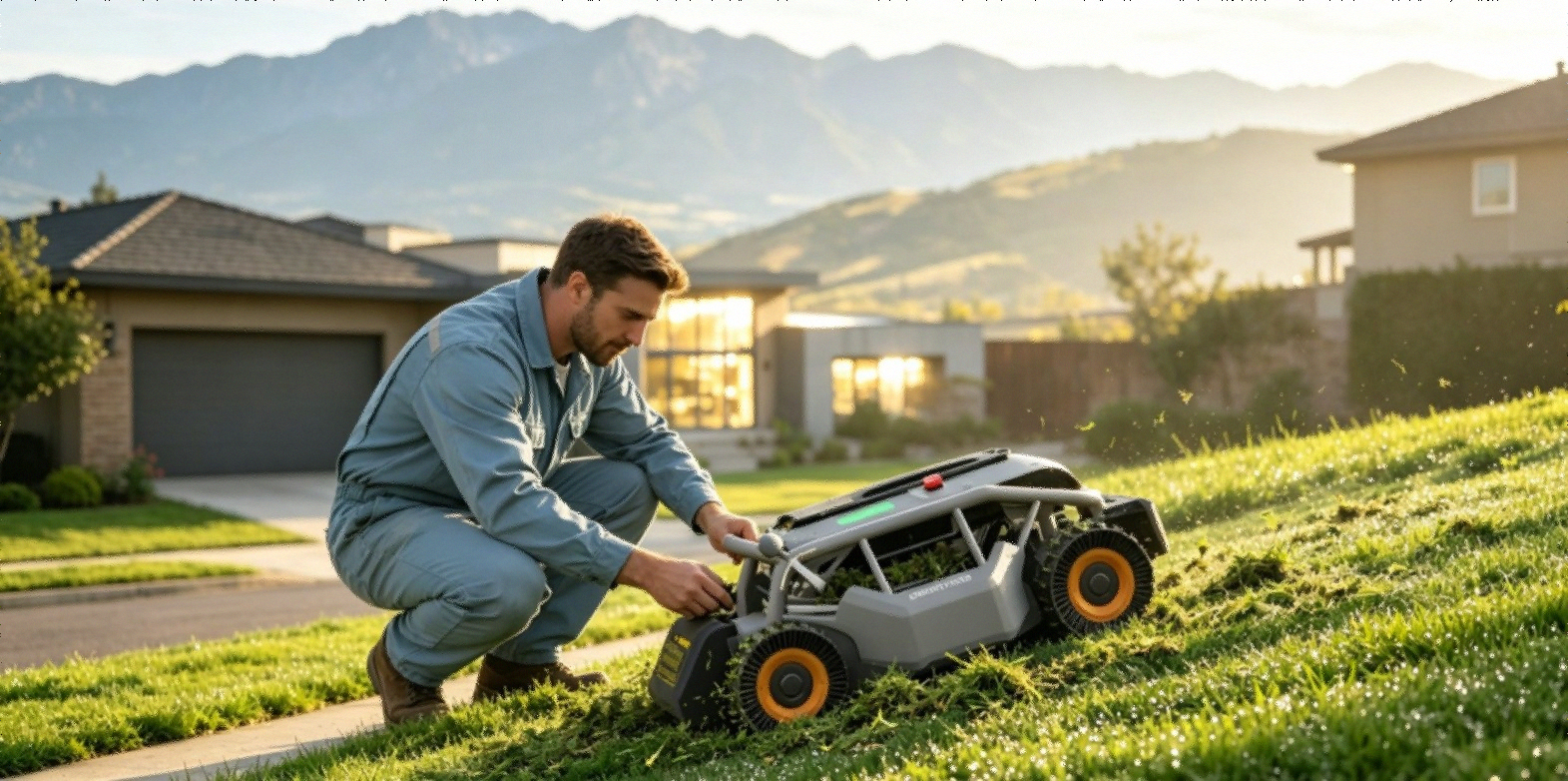
The handheld remote runs four control modes for different operators and handedness:
Single stick (right-handed) — One joystick for speed and direction. Simple, good entry point if you’re new to RC equipment.
Single stick (left-handed) — Same setup, mirrored for left-hand dominant users.
Dual stick — Two joysticks, one per side, like a tank or tracked vehicle. More precise, steeper learning curve.
Auto-turn assist — The mower handles the turn at the end of each pass and lines up the next one. Useful on flat ground. Less useful on slopes, where the rapid turning can chew up turf.
The 5ms remote latency is the number actually worth paying attention to. Most consumer RC systems run 20-50ms. At 5ms, you steer and it responds — no lag in between. On a steep slope near water, that responsiveness isn’t a nice-to-have, it’s a safety feature.
The remote also controls blade speed, so you can dial back RPM for light grass or push to max for dense growth.
⚠️ Key Tip: On slopes above 35 degrees, switch to manual control for every turn instead of relying on auto-turn assist. The assisted turning is tuned for flat-ground efficiency and gets too aggressive on steep terrain, tearing up turf at the turn points.
The 21-Inch Mulching Blade and Three-Season Use
The ECB version ships with both a standard cutting blade and a 21-inch mulching blade. Swapping takes a few minutes and opens up three distinct seasonal uses:
Spring: Add the optional Trailer Hitch Kit and use it to haul yard waste, compost, or materials. The 4WD traction makes it a decent utility hauler on rough ground.
Summer: Standard blade for regular mowing. 21-inch width means fewer passes than the smaller autonomous robots, which mostly run 8-10 inch cutting widths.
Fall: Mulching blade shreds fallen leaves into the 70L grass bag, fine enough that the bag fills up slower before you need to dump it.
The optional Mowfun FPV camera lets you watch the mowing from indoors — useful for sections out of direct line of sight, or if you’d rather monitor a slope job without standing near the edge yourself.
Mowrator S1 Model Lineup: Which Version to Buy
| Model | Price | Drive | Battery | Best For |
|---|---|---|---|---|
| 2WD 12Ah DT | $2,499 | 2WD | 12Ah | Moderate slopes under 30° |
| 2WD 18Ah | $2,999 | 2WD | 18Ah | Moderate slopes, longer runtime |
| 4WD 12Ah | $3,149 | 4WD | 12Ah | Steep slopes, smaller area |
| 4WD 18Ah | $3,599 | 4WD | 18Ah | Steep slopes, larger area |
| 4WD 18Ah ECB | $3,959 | 4WD | 18Ah + ECB | Maximum slope + best control modes |
| 4WD 18Ah WW | $4,299 | 4WD | 18Ah + wide wheels | Extreme grip for wettest steepest terrain |
When to pick 4WD over 2WD: Any slope consistently over 25-30 degrees. Wet grass or soft ground even on moderate slopes. Anywhere near water or ditches where a slip actually has consequences.
When to pick 18Ah over 12Ah: Properties over 0.6 acres, or multiple sessions, or mulching — which draws more power than straight cutting. The 90-minute recharge on the 18Ah means one rest break and you’re back to full.
When ECB is worth it: If the control mode options matter to you — left-handed operation, single vs. dual stick, the upgraded auto-turn programming.
Comparing the Mowrator S1 to Autonomous Robot Mowers
Related Post: ECOVACS Goat A2000 vs A3000 Comparison 2026
Related Post: Segway Navimow i105N Review Small Yards Trees
Related Post: Robot Lawn Mower Buying Guide 2026
The honest comparison:
Autonomous robot mowers win at unattended operation, regular maintenance mowing on flat-to-moderate terrain, quiet running (most sit at 55-65 dB, close to the Mowrator’s 63 dB), and scheduled cleaning without you involved at all.
The Mowrator S1 wins at terrain too steep or irregular for autonomous navigation, immediate responsive control in hazardous spots, leaf shredding and mulching, and any situation where the physical labor is the actual problem — not just the attention it demands.
They’re not really fighting for the same buyer. If you’re cross-shopping the Mowrator S1 against a Goat A3000 or Segway Navimow, you’ve probably got a property that needs both, or you need to get clearer on which terrain problem you’re actually solving.
Related Post: ECOVACS Goat A3000 LiDAR Pro Review
Related Post: Segway X430 vs ECOVACS A3000 Comparison 2026
Frequently Asked Questions
How does the Mowrator S1 handle wet grass? The grip tread tires hold traction on wet slopes noticeably better than standard mower tires. On wet moderate slopes, performance stays solid. On extreme slopes (40°+) in wet conditions, some slipping shows up on turns — the standard tires (not the wide grip ones) tend to do better here.
Does the Mowrator S1 require any app setup or RTK boundary installation? No. That’s one of the real advantages over autonomous robot mowers. Power it on, sync the remote, go. No GPS boundary, no app, no perimeter wire. Setup takes minutes, not hours.
How loud is the Mowrator S1? 63 dB at the measured distance — roughly a normal conversation or a window AC unit, well under a gas mower’s typical 85-95 dB. From a distance while operating the remote, it’s a non-issue.
What’s the ROI calculation vs. lawn services? Mowrator’s own numbers suggest recovering the cost in 24-30 months against professional lawn service fees, with real savings from year three on. If you’re paying $150-200 a month for a service to handle your steep sections, the math works out over 3-4 years.
Can it handle ditches and pond edges? Yes — that’s a core use case. The remote lets you keep the machine near water edges or in drainage channels while you stay back at a safe distance. Ultrasonic sensors handle collision detection, and emergency stop plus blade auto-stop kick in when obstacles are detected.
What the Current Reviews Say
Only four reviews at the time of writing — this is a newer product — so the early feedback is positive but thin. The 4.7/5 average breaks down to 70% five-star and 30% four-star, no negative ratings yet.
The consistent themes: heavy, durable build quality, slope performance that beats expectations, and the turning algorithm on steep grades as the main thing people want improved. Mowrator supports OTA firmware updates, and a few reviewers are hoping the turning behavior gets refined that way rather than through a hardware fix.
The takeaway across the early reviews is pretty consistent: solid build, better results with the slope tires, and noticeably less turf damage when you skip the auto-turns in favor of straight up-and-back passes.
Final Verdict
The Mowrator S1 4WD 18Ah ECB is built for one job: mowing terrain that’s genuinely difficult or dangerous with a walk-behind or riding mower. At that job, it delivers.
The 4WD system with grip tread tires, 1000W drivetrain, and 1985.6W blade motor on a 56V 18Ah LiFePO4 battery is serious engineering, not marketing language. The 5ms remote response makes it feel precise in situations where precision actually matters. Three-season versatility — mowing, mulching, hauling with the blade and hitch kit options — stretches its value past just cutting grass.
$3,959 isn’t a casual number. But if you’re paying a lawn service monthly to deal with your steep sections, or you’ve quietly given up on mowing parts of your property because the risk isn’t worth it, the math works in this machine’s favor.
Slopes over 30 degrees, creek banks, pond edges, or any physical limitation that makes a gas mower impractical — the Mowrator S1 4WD earns a serious look.
Check current price on Amazon — Mowrator S1 4WD 18Ah ECB
Related reading:
- Best Robot Lawn Mower 2026
- Robot Lawn Mower Buying Guide 2026
- RTK vs LiDAR Robot Mower 2026
- ECOVACS Goat A2000 LiDAR Pro Review
- ECOVACS Goat A2000 LiDAR Pro Review 2026
- ECOVACS Goat A3000 LiDAR Pro Review
- ECOVACS Goat A2000 vs A3000 Comparison 2026
- Segway Navimow X430 Review 2026
- Segway Navimow i105N Review Small Yards Trees
- Segway X430 vs ECOVACS A3000 Comparison 2026