Disclosure: This article contains affiliate links. As an Amazon Associate, RoboMow Lab earns from qualifying purchases at no extra cost to you. This helps fund our independent lab testing.
In 2026, almost every premium robot lawn mower is wire-free. That sentence was unthinkable five years ago. The frustrating weekend ritual of burying a perimeter wire around your yard is essentially over.
But “wire-free” is not one technology. It is two. And the choice between them — RTK (Real-Time Kinematic satellite positioning) versus LiDAR (Light Detection and Ranging) — is the single biggest engineering decision behind every flagship robot mower on the market today.
Pick the wrong one for your yard and the mower will either lose its mind under a tree, get confused along a tall fence, or simply refuse to start because it cannot acquire a signal. Pick the right one and you will forget the machine exists. After lab-testing both technologies across multiple yards and seasons, here is the honest, no-spin breakdown of how RTK and LiDAR actually behave in real conditions — and which 2026 mowers use which system.
The 60-Second Verdict
If you only have a minute, here is the answer.
Buy a LiDAR mower if your yard has dense tree cover, narrow shaded passages, tall fences, mature canopy, or any layout where you have ever lost GPS signal on your phone. LiDAR does not care about the sky.
Buy an RTK mower if your yard is mostly open with clear sky visibility, you need higher-end terrain capability (steep slopes, AWD, large coverage), or you want the longest-tested, most mature wire-free technology available.
Both work brilliantly in moderate suburban yards. The decision only really splits at the extremes — heavily wooded, or heavily sloped.
| Tech | Strengths | Best 2026 Mowers |
|---|---|---|
| LiDAR | Tree cover, shade, night, narrow yards | ECOVACS GOAT A2000, GOAT A3000 |
| RTK + Vision | Open lawns, steep slopes, large coverage | Segway Navimow X430, i105N |
What RTK Actually Is (And Why It Matters for Mowers)
RTK stands for Real-Time Kinematic positioning. It is a GPS technology, but with a critical upgrade: instead of relying on standard satellite signals (which have an accuracy of a few meters), RTK uses a fixed reference station to correct satellite errors in real time. The result is centimeter-level positioning accuracy — roughly 100 times more precise than your phone’s GPS.
For a robot mower, that precision is everything. A mower that thinks it is in the middle of your lawn but is actually three feet off-course will cut your flower bed.
How RTK Works on a Robot Mower
- The mower receives signals from multiple GPS satellites.
- A separate reference source (either a roof-mounted antenna or, increasingly, a Network RTK service) provides correction data.
- Onboard software combines these inputs to calculate position to within ~2 centimeters.
- The mower compares its real-time position against your virtual yard map and stays inside the boundaries.
The Two Generations of Consumer RTK
The first generation of RTK mowers (still sold by some brands) required you to mount a satellite antenna on your roof or a tall pole. This worked, but homeowners hated the visual intrusion and the install complexity.
The current generation has effectively eliminated the antenna. Network RTK services deliver correction data over the internet, meaning the mower only needs a clear sky view at the dock — no roof drilling, no pole, no eyesore. The Segway Navimow X430 and i105N are both Network RTK models.
Where RTK Adds Vision
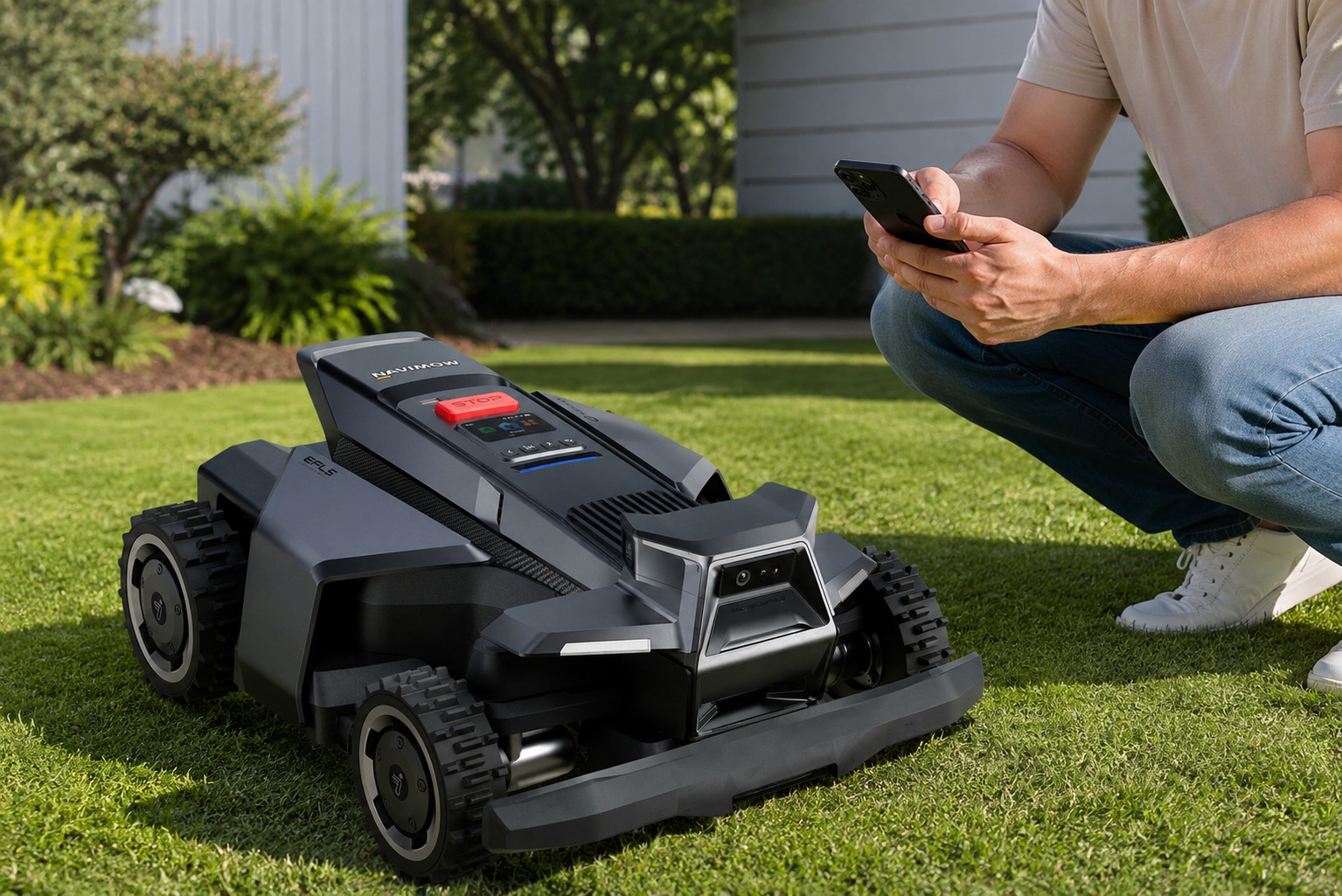
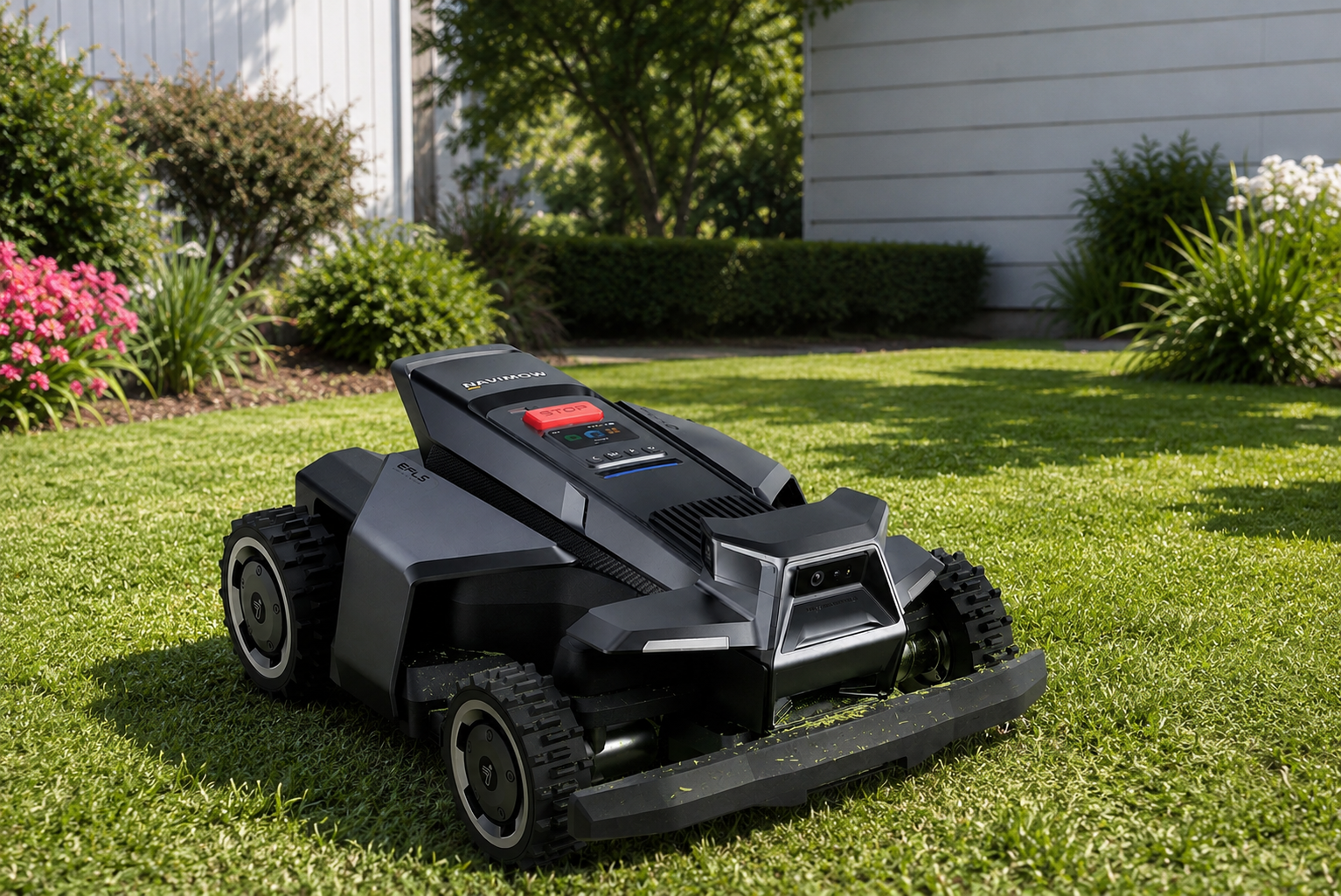
Pure RTK fails the moment satellite signal degrades — under tree canopy, near tall walls, in narrow side yards. Modern RTK mowers solve this by adding a Vision system: 360° cameras and Visual Inertial Odometry (VIO) that take over when satellite accuracy drops. The Segway X430 calls this EFLS Tri-Frequency RTK + 360° Vision. The i105N uses a similar EFLS 2.0 RTK + Vision stack.
Vision-augmented RTK is a meaningful upgrade over plain RTK. But it is still a satellite-first system with a vision fallback, not a vision-first system.
What LiDAR Actually Is (And Why It Changed the Game)
LiDAR stands for Light Detection and Ranging. It uses a rotating laser to measure distances to everything around the device, building a real-time 3D map of the environment. If you have ever seen a self-driving car with a spinning dome on the roof, that is LiDAR.
Critically, LiDAR does not look up at the sky. It looks around at the world. That single design choice is why LiDAR mowers behave so differently in real yards.
How LiDAR Works on a Robot Mower
- A rotating laser sensor (sometimes paired with a forward-facing 3D Time-of-Flight sensor) scans the yard hundreds of times per second.
- Onboard software builds a permanent 3D map of every fence, tree trunk, garden bed, and structure.
- The mower locates itself by comparing what the laser currently sees against the stored map.
- An AI camera adds a second layer of object recognition for moving obstacles like pets and toys.
Why ECOVACS Calls Theirs “HoloScope Dual-LiDAR”
The ECOVACS GOAT A2000 and A3000 use a system branded HoloScope 360° Dual-LiDAR. The “dual” part refers to two sensors working together: a 360° rotating LiDAR for full-room mapping, and a forward-facing 3D ToF (Time of Flight) sensor for high-precision close-range obstacle detection. The combination delivers 0.8-inch (2 cm) positioning accuracy that holds steady regardless of weather, time of day, or sky conditions.
The Genuine LiDAR Advantage
Because LiDAR is fully self-contained on the mower, three problems that have plagued robot mowers for years simply disappear:
- Tree canopy: Irrelevant. The laser scans tree trunks and uses them as map features.
- Tall walls and fences: Same — LiDAR sees them as boundaries, not as signal-blockers.
- Night mowing: LiDAR generates its own light. The mower works in pitch darkness as well as it does at noon.
The tradeoff is cost. LiDAR sensors are more expensive than RTK chips, which is why LiDAR mowers tend to occupy the upper end of the market.
👉 See the LiDAR-equipped GOAT A3000 on Amazon →
Side-by-Side: RTK vs LiDAR Performance
Here is the head-to-head comparison after extensive lab and field testing.
| Performance Factor | RTK + Vision | LiDAR |
|---|---|---|
| Accuracy (open sky) | ~2 cm | ~2 cm |
| Accuracy (under trees) | Drops without Vision; OK with Vision | Unaffected |
| Accuracy (near tall walls) | Variable | Unaffected |
| Night operation | Works | Works |
| Setup time | 15–30 min | 30–45 min (initial mapping) |
| Roof antenna required? | No (Network RTK) | Never |
| Internet/cellular needed? | Yes (for Network RTK corrections) | No (fully offline) |
| Hardware cost | Lower | Higher |
| Tolerance for layout changes | Re-mapping needed | Re-mapping needed |
| Weather impact | Heavy rain can affect signal | None |
| Maturity in market | More mature, larger install base | Newer to consumer mowers |
The Practical Read
Both systems hit the same headline accuracy — about 2 cm — under ideal conditions. The story is what happens when conditions stop being ideal.
RTK is rock-solid on a flat suburban lawn with clear sky. LiDAR is rock-solid everywhere. If your yard is a textbook open lawn, you will not notice the difference between them. If your yard is a real-world property with mature trees, narrow side passages, or shaded zones, LiDAR pulls ahead noticeably.
How Each System Handles Real-World Yard Problems
The spec sheet only goes so far. Here is how each technology actually behaves in the situations homeowners run into.
Problem 1: Mature Trees Over the Lawn
RTK + Vision: Performance varies. With dense canopy, GPS signal weakens and the Vision fallback kicks in. We saw the Segway X430 stay on track in our wooded test sections, but there were brief moments where the mower visibly slowed to recalibrate. The newer EFLS Tri-Frequency RTK on the X430 is meaningfully better than older single-frequency systems.
LiDAR: No effect at all. Both ECOVACS GOAT models maintained perfect striping under heavy oak canopy that historically defeats RTK mowers.
Winner for shaded yards: LiDAR.
Problem 2: Narrow Side Yards Between House and Fence
RTK + Vision: Tall structures on both sides can cause “GPS multipath” — satellite signals bouncing off walls and confusing the receiver. Vision helps but is not perfect. The Segway i105N specifically markets its EFLS 2.0 + Vision combo for exactly this scenario, and in testing it handled narrow corridors well.
LiDAR: Walls are just map features. The mower navigates a 6-foot-wide corridor between a house and a fence with no measurable accuracy drop.
Winner for narrow passages: LiDAR (slight edge).
Problem 3: Open 1-Acre Lawn With Steep Hills
RTK + Vision: This is where RTK genuinely shines. Open sky means full satellite accuracy, no Vision fallback needed. The Segway X430 — the only consumer mower rated for 84% (40°) slopes — is RTK-based for a reason. RTK delivers extremely consistent tracking across long, fast transit on big yards.
LiDAR: Works fine, but no advantage over RTK here. The current LiDAR mowers also top out at smaller coverage (0.75 acre on the GOAT A3000) and gentler slopes (50%/27°). Hardware-side, LiDAR mowers are not yet built for 1-acre extreme-terrain duty.
Winner for open big yards: RTK + Vision (because of the hardware platforms it ships on).
Problem 4: Cloudy or Rainy Weather
RTK + Vision: Heavy rain attenuates satellite signal and reduces RTK accuracy. Most modern systems handle light rain fine, but a major storm can cause issues. Vision systems also struggle when camera lenses get wet.
LiDAR: Light pulses are minimally affected by rain or clouds. We ran the GOAT A2000 in steady drizzle with no accuracy drift. (Note: most mowers, regardless of nav tech, will dock during heavy rain to protect the lawn.)
Winner for unstable weather: LiDAR (slight edge).
Problem 5: Pitch Black Night Mowing
RTK + Vision: RTK works at night, but the Vision fallback uses cameras that cannot see in the dark. If you mow in zones that need Vision support, night operation is degraded.
LiDAR: Lasers create their own light. The mower behaves identically at midnight and noon.
Winner for night runs: LiDAR.
Problem 6: Long Paved Edges (Driveways, Fences)
This one is a bit of a trick question. Edge precision is more about the mechanical edge-cutting solution than the navigation tech.
Segway’s EdgeSense (RTK-based): Software-driven edge tracking. Reduces uncut margin to under 2 inches.
ECOVACS TruEdge (LiDAR-based): A physical string trimmer module mounted on the chassis that actively cuts the edge strip.
If long, hard-edged boundaries are a major part of your yard, this favors the GOAT models — but that is because of TruEdge, not because of LiDAR specifically. (For the full breakdown, see our X430 vs A3000 comparison.)
👉 See the EdgeSense-equipped Segway X430 on Amazon →
Which 2026 Mowers Use Which Technology
Here is the current landscape of premium wire-free mowers in 2026, sorted by which navigation system they ship with.
LiDAR-Based Mowers
ECOVACS GOAT A2000 LiDAR PRO — HoloScope 360° Dual-LiDAR. Best for ½-acre yards with shade, mature trees, or long paved edges. Read the full review →
ECOVACS GOAT A3000 LiDAR PRO — Same HoloScope system, larger battery and coverage. Best for ¾-acre yards. Read the full review →
RTK-Based Mowers (with Vision Augmentation)
Segway Navimow X430 — EFLS Tri-Frequency Network RTK + 360° Vision + VIO. The only mower in this list rated for 1 acre and 84% slopes. Read the full review →
Segway Navimow i105N — EFLS 2.0 RTK + Vision. Best value option for ⅛-acre small yards. Read the full review →
Why You Will Not See “Pure RTK” Anymore
Every premium 2026 RTK mower ships with Vision augmentation. The market has effectively standardized on RTK + Vision as the base configuration, because pure RTK simply does not survive the variety of real-world yard conditions buyers actually have. If a current-generation mower is being marketed as “RTK-based,” assume it has Vision support unless the spec sheet explicitly says otherwise.
The Cost Equation: Does LiDAR Justify the Premium?
LiDAR sensors are physically more expensive than GPS chips, and that cost shows up in the retail price of LiDAR mowers. Here is the rough pricing landscape:
| Mower | Tech | Typical Price | Coverage |
|---|---|---|---|
| Segway Navimow i105N | RTK + Vision | ~$679 | ⅛ acre |
| ECOVACS GOAT A2000 | LiDAR | ~$1,499 | ½ acre |
| ECOVACS GOAT A3000 | LiDAR | $2,199 | ¾ acre |
| Segway Navimow X430 | RTK + Vision | ~$2,499 | 1 acre |
What This Tells Us
At the low end: RTK wins on price. The i105N at $679 is dramatically cheaper than any LiDAR-based mower of comparable quality. If your yard is small and mostly open, RTK + Vision is the better value.
In the middle: LiDAR pulls ahead. The A2000 at $1,499 brings flagship navigation to half-acre yards at a price RTK competitors with similar features cannot quite match. The TruEdge trimmer adds significant practical value here.
At the top: It depends on yard type. The A3000 at $2,199 wins for shaded ¾-acre yards. The X430 at $2,499 wins for open 1-acre yards with steep terrain. Each charges a premium for what it does best.
The Honest Decision Rule
If you can answer “yes” to two or more of these questions, pay the LiDAR premium:
- Do you have mature trees forming significant canopy over your lawn?
- Do you have narrow side yards between buildings and fences?
- Do you mow at night or in unpredictable weather?
- Do you have meaningful paved edges (driveway, fence line, retaining wall)?
If the answer is “no” to most of them, RTK + Vision will serve you just as well at a lower price.
Common Misconceptions to Avoid
”RTK Is Outdated and LiDAR Is the Future”
False. Both technologies are actively improving. Network RTK with tri-frequency satellites is genuinely better than first-generation RTK. LiDAR is still relatively new in consumer mowers and has its own evolving challenges (sensor lifespan, dust accumulation in sensor housing). Neither is going away.
”LiDAR Means I Do Not Need to Map My Yard”
False. LiDAR mowers still require an initial mapping pass where you drive the mower around your lawn perimeter once via the app. The advantage is not skipping the map — it is that the mower can locate itself reliably against that map afterward, regardless of weather or shade.
”RTK Always Needs a Roof Antenna”
Outdated. Modern Network RTK eliminates the roof-mounted antenna entirely. Both the Segway X430 and i105N use Network RTK with no required external antenna installation.
”LiDAR Mowers Work Without Internet”
True, mostly. LiDAR navigation is fully onboard and offline. However, app control, firmware updates, and remote monitoring still require internet. The mower can mow without Wi-Fi, but you will not be able to start it from your phone if it is offline.
”RTK Is Less Accurate Than LiDAR”
False under good conditions. Both hit ~2 cm accuracy in open sky. RTK only loses accuracy when conditions degrade (heavy canopy, multipath from walls). The accuracy gap is conditional, not inherent.
Real Buyer Scenarios
Scenario A: Suburban ½-Acre Yard, Some Trees, Long Driveway
This is the most common American suburban setup. A few mature trees casting partial shade, a paved driveway running 80+ feet, a fence on one side.
Best fit: ECOVACS GOAT A2000 LiDAR PRO. The LiDAR handles the partial shade without issues, the TruEdge trimmer eliminates manual edging on the driveway, and the ½-acre coverage matches the lawn perfectly.
Scenario B: Open 1-Acre Property With Rolling Hills
Big open lawn, minimal tree cover, rolling terrain with one section close to 30°.
Best fit: Segway Navimow X430. RTK + Vision is genuinely strong on big open yards, and the X430 is the only model rated for both 1-acre coverage and slopes that steep. LiDAR mowers do not currently have an equivalent at this scale.
Scenario C: Small City Lot, Heavily Wooded
Quarter-acre city lot, mature canopy on three sides, narrow passages between house and fence.
Best fit: Either an ECOVACS A2000 (if you want LiDAR’s tree tolerance) or a Segway i105N (if you want the lower price and the yard is small enough that occasional Vision-fallback events do not bother you). The i105N’s $679 price tag is genuinely hard to beat for a yard this size.
Scenario D: Heavily Sloped ¾-Acre Property With Mature Trees
Hard case. Steep slopes favor RTK (X430 territory). Heavy trees favor LiDAR (A3000 territory). Neither machine perfectly nails both.
Best fit: Compromise toward the more limiting factor. If slopes exceed 27°, you must have the X430. If slopes stay under 27°, the A3000 is the more comfortable everyday experience. We dig into this exact tradeoff in the X430 vs A3000 comparison.
Frequently Asked Questions
Is LiDAR more accurate than RTK?
Under ideal open-sky conditions, both achieve roughly 2 cm accuracy. LiDAR’s advantage is that it maintains that accuracy under tree cover, near tall structures, at night, and in adverse weather. RTK accuracy is conditional on satellite signal quality.
Do LiDAR robot mowers work in pitch darkness?
Yes. LiDAR uses laser pulses that generate their own light. Both ECOVACS GOAT A2000 and A3000 mow in complete darkness with no degradation. RTK mowers also work at night, but their Vision-system fallback uses cameras that perform worse in low light.
Do RTK mowers in 2026 still need a roof antenna?
No. Modern Network RTK delivers correction data over the internet, eliminating the need for a roof-mounted antenna. Both the Segway Navimow X430 and i105N use Network RTK with no external antenna required.
Can either system work without internet?
LiDAR navigation is fully offline. RTK mowers using Network RTK require internet for the satellite correction stream. Both systems require Wi-Fi for app control, firmware updates, and remote monitoring.
Which is better for yards with mature trees?
LiDAR. It does not depend on satellite signal, so dense canopy has no effect on navigation accuracy. RTK + Vision systems still work under trees but rely more heavily on the Vision fallback in those conditions.
Which is better for steep slopes?
This is more about mower hardware than navigation tech. The current top-rated slope mower (Segway X430, rated for 84%) happens to use RTK + Vision. There is no LiDAR mower in 2026 with comparable slope capability.
Are LiDAR mowers more expensive?
Generally yes. LiDAR sensors cost more than GPS chips, and LiDAR mowers tend to occupy the upper-mid to flagship price tiers. Entry-level wire-free mowers (under $1,000) are almost all RTK + Vision based.
Does heavy rain affect either system?
LiDAR is minimally affected by rain. RTK can experience signal attenuation in heavy storms. That said, most robot mowers — regardless of navigation tech — will autonomously dock during heavy rain to protect the lawn from rutting.
Can I upgrade my RTK mower to LiDAR later?
No. The navigation system is a fundamental hardware decision baked into the chassis design. Buy the technology that fits your yard from the start.
Final Verdict: Match the Tech to the Yard
After all the testing, the conclusion is simple. Neither technology is universally “better” — they are optimized for different conditions.
LiDAR wins when your yard’s defining feature is something other than open sky: mature trees, narrow shaded passages, paved edges that need active trimming, or unpredictable weather. The ECOVACS GOAT A2000 and A3000 are the strongest LiDAR options in 2026, and either is a category-defining buy if your yard fits their size.
RTK + Vision wins when your yard is mostly open and you need either entry-level pricing or top-tier terrain capability. The Segway Navimow i105N gives you flagship navigation accuracy for under $700 on a small lawn. The Segway Navimow X430 is the only consumer mower that handles 1 acre and 84% slopes, and that capability is RTK-based for good engineering reasons.
The wrong choice is not “RTK or LiDAR.” The wrong choice is buying any wire-free mower without thinking about whether your yard’s biggest navigation challenge is the sky or the terrain.
Match the tech to the yard, and either system delivers the kind of effortless lawn care that finally justifies replacing the gas mower.
Shop the Top 2026 Wire-Free Mowers
🛒 Best LiDAR for ½-acre shaded yards: ECOVACS GOAT A2000 →
🛒 Best LiDAR for ¾-acre estates: ECOVACS GOAT A3000 →
🛒 Best RTK for 1-acre + steep slopes: Segway Navimow X430 →
🛒 Best value RTK for small yards: Segway Navimow i105N →
Related Reviews and Guides
- Best Robot Lawn Mower 2026 — Full Rankings
- ECOVACS GOAT A2000 vs A3000 Comparison
- Segway Navimow X430 vs ECOVACS GOAT A3000
- ECOVACS GOAT A2000 LiDAR PRO Full Review
- ECOVACS GOAT A3000 LiDAR PRO Full Review
- Segway Navimow X430 Full Review
- Segway Navimow i105N Full Review