Disclosure: This article contains affiliate links. As an Amazon Associate, RoboMow Lab earns from qualifying purchases at no extra cost to you. This helps fund our independent lab testing.
Buying your first robot lawn mower in 2026 is a strange experience. The category has matured fast — wire-free is now standard, AI obstacle detection is real, and slope ratings have nearly tripled in three years. But the marketing has sprinted ahead of the engineering. Every brand promises “smart navigation,” every spec sheet brags about “AI vision,” and every product page is studded with acronyms most buyers cannot decode.
The result: smart, capable buyers spending $2,000+ on machines that turn out to be wrong for their yards.
This guide cuts through the noise. After lab-testing every major flagship in 2026, here are the 7 specifications that actually determine whether a robot mower works for you — and the marketing claims you can safely ignore. Read this before you click “Buy” on any product page.
The 90-Second Decision Path
If you only have time for one section, walk through these three questions in order. Most buyers can pick the right mower in under two minutes.
Question 1: How big is your mowable lawn?
Pull up Google Maps, draw a rough perimeter, and check the actual square footage. Coverage rating is the single most important spec, and getting it wrong wastes money in both directions.
| Lawn Size | Recommended Class | Top 2026 Pick |
|---|---|---|
| Under 0.25 acre | Compact / Best Value | Segway Navimow i105N (~$679) |
| 0.25 – 0.5 acre | Mid-Range | ECOVACS GOAT A2000 (~$1,499) |
| 0.5 – 0.75 acre | Premium | ECOVACS GOAT A3000 ($2,199) |
| 0.75 – 1 acre | Heavy-Duty | Segway Navimow X430 (~$2,499) |
| Over 1 acre | Commercial-grade | Outside this guide |
Question 2: What is the steepest slope on your property?
Walk your yard with an incline app on your phone. Measure the steepest section honestly — no rounding down.
- Under 27°: Any flagship will work.
- 27° – 40°: Only the Segway Navimow X430 (rated 84%/40°) handles this.
- Over 40°: No consumer robot mower is built for this. You need a tracked commercial unit.
Question 3: What is your yard’s defining navigation challenge?
This is the question most buyers skip — and the one that causes the most regret.
- Heavy tree cover or shaded zones? → Pick LiDAR (ECOVACS GOAT lineup).
- Mostly open lawn with steep slopes or large coverage? → Pick RTK + Vision (Segway Navimow lineup).
- Long paved edges (driveway, fence, retaining wall)? → Pick a model with a physical edge trimmer (ECOVACS TruEdge).
If those three questions did not give you a clear winner, the rest of this guide unpacks each spec in detail.
Spec #1: Coverage Area — The Spec Buyers Get Wrong Most Often
Manufacturers state a maximum coverage figure. Treat it as a ceiling, not a target. A mower rated for 0.5 acre will technically work on a 0.5-acre yard, but it will spend most of its day at the dock recharging. The lawn will feel “perpetually mid-cycle” rather than “done.”
The 80% Rule
A rough working principle: pick a mower whose maximum rated coverage is at least 25% larger than your actual mowable area. So a 0.4-acre yard wants a 0.5-acre rated mower, and a 0.6-acre yard wants a 0.75-acre rated mower.
Why Manufacturer Numbers Are Optimistic
Coverage ratings assume:
- A mostly rectangular lawn shape
- Minimal obstacle density
- Clear sky for navigation
- No slopes worth mentioning
Real American suburban yards have flower beds, swing sets, garden borders, and tree wells. Each obstacle adds path complexity, which reduces effective coverage. A 0.5-acre yard with a complex layout can easily behave like a 0.6-acre yard from the mower’s perspective.
Hidden Cost: Battery Anxiety
Buyers who size their mower at the absolute coverage ceiling end up frustrated. Every cycle becomes a gamble — will the battery last? Will the mower finish before the kids get home from school? Buy yourself headroom. Future you will thank present you.
👉 See coverage-rated mowers on Amazon →
Spec #2: Slope Capability — The Hardest Limit to Cheat
Slope rating is the single least-fudgeable spec on the sheet. A mower that says it climbs 50% (27°) genuinely climbs 50%. A mower that says 84% (40°) genuinely climbs 84%. There is no “interpretation.” There is no software fix. The chassis either has the traction and the geometry to grip the hill, or it slides off it.
Slope Ratings Across the 2026 Lineup
| Mower | Max Slope | Drive System |
|---|---|---|
| Segway Navimow i105N | ~30% | 2WD |
| ECOVACS GOAT A2000 | 50% (27°) | 2WD |
| ECOVACS GOAT A3000 | 50% (27°) | 2WD |
| Segway Navimow X430 | 84% (40°) | AWD (4WD) |
What Each Slope Range Actually Looks Like
- 20% (11°): Mild backyard slope. Most yards are at or below this.
- 27% (15°): Noticeable hill. Walking up gets harder.
- 50% (27°): Steep. You feel it in your legs walking up.
- 84% (40°): Black-diamond ski run territory. Most homeowners do not have this — but those who do have no other consumer-grade option than the X430.
The Weight-vs-Slope Tradeoff
Heavier mowers (X430) handle steep slopes better because they have more downward force on the wheels. Lighter mowers (i105N) are easier on the lawn but trigger tilt errors on grades that the X430 cruises through.
If you have any slope above 27°, this single spec ends the comparison. Buy the X430. There is no second option in 2026.
👉 Steep yard? Get the Segway X430 on Amazon →
Spec #3: Navigation Technology — The Spec That Determines Reliability
This is the most technically dense decision, and it deserves its own deep-dive (we wrote one: [RTK vs LiDAR Robot Lawn Mowers]. The short version:
RTK + Vision (Segway Navimow lineup)
- Uses GPS satellites + Network RTK corrections + 360° camera fallback
- ~2 cm accuracy under open sky
- Performance varies under heavy tree cover (Vision picks up the slack)
- Available on entry-level and flagship Segway models
- More mature, larger install base
LiDAR (ECOVACS GOAT lineup)
- Uses rotating laser sensors + 3D Time-of-Flight camera + AI vision
- ~2 cm accuracy regardless of sky conditions
- Unaffected by trees, shade, walls, or weather
- Tends to occupy the upper price tiers
- Newer to consumer mowers, but rapidly maturing
The Real Decision
If you can confidently answer yes to any of these, pay the LiDAR premium:
- I have mature trees casting significant canopy
- I have narrow side yards between buildings
- I want to mow at night
- I live in an area with frequent overcast or rainy weather
If your yard is mostly open with clear sky access, RTK + Vision is the better value — and the Segway X430 in particular gets you 1-acre coverage and 84% slope capability that no LiDAR mower currently matches.
What “Wire-Free” Actually Means in 2026
Both RTK and LiDAR mowers are wire-free. Neither requires you to bury a perimeter wire around your lawn. Setup for both is app-driven: you walk the mower around your yard once via smartphone, and it builds a permanent virtual map.
Modern RTK has also eliminated the roof-mounted antenna requirement. Network RTK delivers correction data over the internet, so the mower only needs a clear sky view at the dock. Both the Segway X430 and i105N use Network RTK with no antenna installation.
Spec #4: Edge Trimming — The Quiet Game-Changer
This is the spec that separates a “good” robot mower experience from a great one, and it is also the most underrated.
The Problem
Standard robot mowers leave a 3-to-6-inch strip of uncut grass along every fence, driveway, sidewalk, and retaining wall. Why? Because the cutting blade is housed safely under the center of the chassis, physically unable to reach the edge.
The result: even with a “fully autonomous” mower, you still spend 30 minutes every weekend walking the perimeter with a string trimmer. The autonomy is incomplete.
The Two Solutions
Software approach (Segway EdgeSense): The mower hugs boundaries more closely via tighter navigation. EdgeSense reduces the uncut margin to under 2 inches. It does not eliminate it.
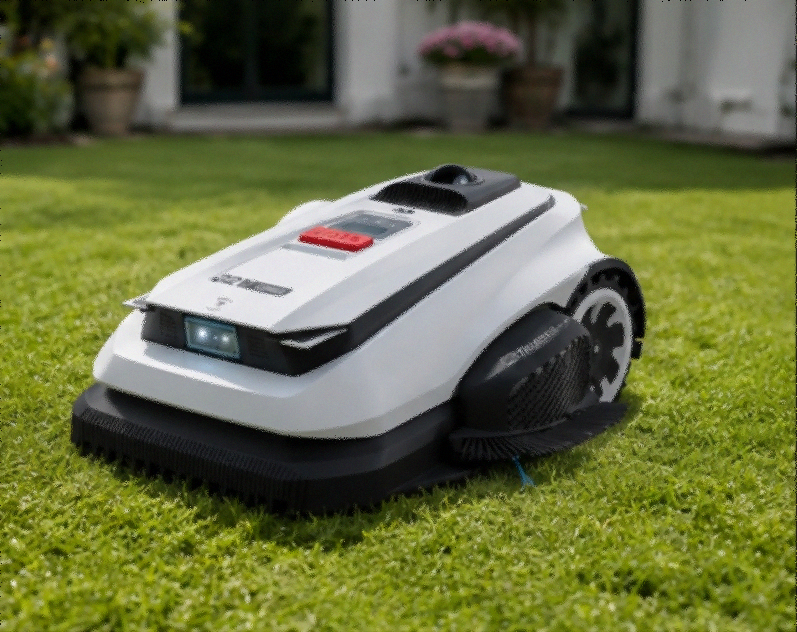
Hardware approach (ECOVACS TruEdge): A physical string trimmer module mounted on the chassis. When the mower detects a hard boundary, the trimmer extends and cuts the edge strip directly.
Why TruEdge Tilts the Decision for Some Yards
Add up the linear feet of “hard edge” in your yard:
- Driveway length × 2 sides
- Sidewalk runs
- Fence line length
- Retaining wall edges
- Patio borders
If the total exceeds 200 linear feet, the time savings from TruEdge are meaningful — typically 20–30 minutes per week of avoided string-trimmer work. Over a mowing season, that is more than 10 hours of recovered weekend.
If your yard is mostly grass with minimal hardscape, the EdgeSense software approach is sufficient and you can skip paying the TruEdge premium.
👉 Eliminate manual edging: Get the ECOVACS A3000 on Amazon →
Spec #5: Obstacle Detection — Marketing Numbers vs Real Performance
Every modern robot mower advertises some obstacle-detection number: “150+ object types,” “200+ object types,” “AI-powered avoidance.” These numbers are real, but they are not the whole story.
What the Numbers Mean
The “X+ object types” claim refers to how many distinct categories the mower’s AI can recognize and route around. Common categories include:
- Pets (dogs, cats)
- Garden hoses
- Children’s toys
- Sprinkler heads
- Patio furniture
- Fallen branches
- Garden tools left out
- Decorative stones and statues
A mower rated for 150 types will reliably handle the vast majority of suburban yard situations. A mower rated for 200+ types adds edge cases — specialty garden tools, large sports equipment, low-profile decorative borders.
What Actually Matters More Than the Number
Detection distance: How close to an obstacle can the mower get before stopping? The ECOVACS GOAT A3000’s stated 1.97-inch detection distance is genuinely best-in-class — tight enough to mow close, far enough to never collide.
Detection consistency: Does the mower stop every time, or only most of the time? In testing, both ECOVACS GOAT models and the Segway X430 stopped reliably on 100% of pet and child-toy presentations. Lower-end mowers from other brands can occasionally miss, especially on objects below the camera’s vertical field of view.
Safety pause logic: What happens after detection? A good mower stops fully, recalculates, and routes around the obstacle. A bad mower stops, then resumes when the obstacle moves slightly — which can mean the mower restarts before a pet has fully cleared.
The Real-World Read
For most yards, the difference between 150 types and 200 types is invisible. But the difference between reliable detection (top-tier flagships) and inconsistent detection (sub-$500 budget mowers) is enormous. Pay for the flagship-tier safety system if you have pets or kids.
Spec #6: Battery and Runtime — Where Coverage Becomes Reality
A mower’s battery determines how its rated coverage actually plays out across a typical mowing session.
The Two Numbers That Matter
Runtime per charge: How long the mower can mow on a single full battery. Charging time: How long until the next runtime is available.
The ratio of these two determines the duty cycle — how much of the day the mower spends mowing versus charging.
Across the 2026 Lineup
| Mower | Battery | Runtime | Charge Time | Area per Charge |
|---|---|---|---|---|
| Segway i105N | Smaller | ~70 min | ~1 hr | ~0.05 acre |
| ECOVACS A2000 | 3,000 mAh | 50 min | ~60 min | ~0.09 acre |
| ECOVACS A3000 | 7,500 mAh | 160 min | 70 min | 0.2 acre |
| Segway X430 | Heavy-duty | Extended | 224W hyper-fast | 1-acre rated |
What This Means in Practice
A 0.6-acre yard takes the A3000 about three full charge cycles to complete. That same yard pushes the A2000 to its design limit, requiring five or six cycles and stretching across most of a workday.
If your mowing window is constrained (you want the lawn done before company arrives, or before kids come home), runtime per charge is genuinely important. If you do not care when the lawn finishes — the mower runs at 2 AM anyway — runtime matters less.
Battery Longevity
Lithium-ion batteries on these flagships are rated for 800–1,200 full charge cycles before significant capacity loss. Translated: 4–6 years of typical use. Replacement battery packs are user-serviceable on most 2026 models, with costs in the $150–$300 range.
Spec #7: App and Smart Home Integration
In 2026, the app is the mower. You map your yard through the app, set schedules through the app, define no-go zones through the app, and monitor cutting history through the app. A bad app makes a great mower frustrating to live with.
What a Good Mower App Does Well
- Multi-zone mapping: Define separate areas for front yard, back yard, side yard.
- Virtual no-go zones: Protect flower beds, garden art, fragile features.
- Schedule flexibility: Different cutting frequencies for different zones.
- Cut height per zone: 1.2”–3.5” range, individually settable.
- Real-time monitoring: Battery, location, current task.
- Firmware updates: OTA (over-the-air) so the mower improves over time.
What to Look for in 2026
All four flagships in this guide handle the basics well. The differences come at the edges:
- Segway app: Polished, mature, supports up to 120 mowing zones on the X430.
- ECOVACS app: Cleaner interface, better visualization of LiDAR-mapped areas, slightly fewer advanced options.
Smart Home Integration
If you live in a smart-home ecosystem (Alexa, Google Home), check that the mower supports your platform. The Segway X430 and i105N support both Alexa and Google Home for voice commands like “Start mowing the back yard.” ECOVACS GOAT integration is currently more limited but expanding.
What Specs You Can Safely Ignore
After all that, here is the equally important other side of the ledger — specs that sound important in marketing but rarely affect ownership.
Cutting Width
Within reason, cutting width is a wash. A 17-inch deck (X430) finishes faster than a 12-inch deck (A3000), but both finish the lawn cleanly. Unless you are racing the clock, cutting width is a secondary concern.
Movement Speed
Mowing speeds in this category run between 2.3 and 2.6 ft/s. The 13% difference between fastest and slowest sounds meaningful but plays out as “finishes 10 minutes earlier” on a typical lawn. Not a decision-driver.
Maximum Number of Zones
Manufacturers brag about supporting 50, 100, or 120 mowing zones. The vast majority of homeowners use 2–5 zones. If you have a property that legitimately needs 50+ zones, you are running a small estate, not a residential lawn.
Waterproofing Rating
Every flagship in this guide is rated IPX6 or higher. They all survive heavy rain. The differences in waterproof spec do not affect ownership.
Cutting Height Range
Most mowers cut from roughly 1” to 3.5”. This range covers virtually all American grass types and lawn-care preferences. Slight differences here are rarely a decision-driver.
”AI” and “Machine Learning” Claims
Every modern mower uses AI. The claim itself means almost nothing. What matters is what the AI does (object recognition, edge tracking, path planning) and how reliably it does it — measured by the specs in the previous section.
Buying Mistakes to Avoid
After helping hundreds of buyers pick the right mower, here are the recurring traps.
Mistake 1: Sizing to the Spec Sheet, Not Your Yard
Buyers see “rated for 0.5 acre” and buy that mower for their 0.5-acre yard. Then they wonder why the mower never seems “done.” Always size up by 25%.
Mistake 2: Ignoring Slope
A buyer with a 20° back slope buys a 27°-rated mower because “I’ll be fine.” Six months later, they are pushing the mower up the hill manually because it stopped trying. Always check your steepest section honestly.
Mistake 3: Underestimating Tree Cover
“My yard isn’t that shaded” is something we hear constantly from buyers who later return RTK mowers. If your yard has more than two mature trees casting canopy over the lawn, take LiDAR seriously.
Mistake 4: Skipping Edge Trimming
Buyers focus on the main cutting deck and forget about edges. Three months in, they realize they are still string-trimming every weekend. If you have meaningful hardscape boundaries, factor in edge capability before you buy.
Mistake 5: Buying for the Future Yard
“I might add a slope later” or “We might extend the lawn next year” — these are bad reasons to upsize. Buy for the yard you have now. Robot mowers depreciate; you will likely replace this one before your hypothetical future yard arrives.
Mistake 6: Trusting Amazon Reviews on Older Models
Robot mower technology improved dramatically between 2023 and 2026. A 4-star review from 2023 is not commenting on the same product class as today’s flagships. Stick to recent reviews on current-generation models.
The 2026 Top Picks at a Glance
After all that, here is the simplified shortlist.
Best Overall: ECOVACS GOAT A2000 LiDAR PRO (~$1,499)
For most American suburban homeowners with a quarter to half-acre yard, this is the buy. LiDAR navigation, TruEdge edge trimmer, dense-grass cutting power, and category-leading value. Read the full review →
🛒 Get the ECOVACS A2000 on Amazon →
Best for Big Yards: ECOVACS GOAT A3000 LiDAR PRO ($2,199)
Same brilliant navigation as the A2000, but with 2.5× the battery for ¾-acre properties. The right pick for shaded large yards with long paved edges. Read the full review →
🛒 Get the ECOVACS A3000 on Amazon →
Best for Steep Slopes & 1 Acre: Segway Navimow X430 (~$2,499)
The only mainstream consumer mower rated for 84% (40°) slopes and 1-acre coverage. Built like an off-road vehicle. The right pick when terrain is your defining challenge. Read the full review →
🛒 Get the Segway X430 on Amazon →
Best Value: Segway Navimow i105N (~$679)
Flagship-tier RTK + Vision navigation at one-third the price of the LiDAR competitors. Perfect for ⅛-acre city lots. Read the full review →
🛒 Get the Segway i105N on Amazon →
Frequently Asked Questions
What is the most important spec on a robot lawn mower?
Coverage area rating, sized to fit your actual yard with at least 25% headroom. Picking a mower that is undersized for your lawn is the most common buying mistake and the one with the most lasting impact.
Are wire-free robot lawn mowers reliable in 2026?
Yes. Both RTK + Vision and LiDAR navigation systems are mature enough for daily use. The wire-free generation is now the default for premium mowers, and the technology has solved the historic frustrations of perimeter-wire installation.
How much should I spend on a robot lawn mower?
Budget breakdown for 2026:
- Under $700: Entry-level small-yard mowers (Segway i105N is the standout)
- $1,500: Mid-range half-acre mowers with LiDAR (ECOVACS A2000)
- $2,200: Premium ¾-acre LiDAR mowers (ECOVACS A3000)
- $2,500: Heavy-duty 1-acre AWD mowers (Segway X430)
Do robot lawn mowers work in the rain?
Most flagship models are rated IPX6 and survive heavy rain. However, virtually all of them include a rain sensor that returns the mower to the dock during heavy precipitation to protect the lawn from rutting.
Can a robot mower replace my gas mower entirely?
Yes, for ongoing maintenance. No, for the first cut on overgrown grass. Robot mowers are designed for frequent, light maintenance cuts on already-managed lawns. If you have a neglected jungle, do the first cut with a gas mower or hire a service, then let the robot handle weekly upkeep.
How long does setup take?
Plan for 30–60 minutes for first-time setup, including app installation, dock placement, and initial perimeter mapping. Subsequent yard changes take a few minutes through the app.
Do I need internet at the dock?
For RTK mowers using Network RTK, yes — the satellite correction stream comes over the internet. For LiDAR mowers, internet is only needed for app control, firmware updates, and remote monitoring. The mower itself can mow without active internet once mapping is complete.
Will my homeowners’ association allow a robot mower?
Almost always yes. Robot mowers are quieter than gas mowers (typically 58–65 dB) and often run during off-hours. HOA pushback is rare. If your HOA has noise rules, the i105N at 58 dB(A) is the quietest choice.
How long do robot mowers last?
A 2026 flagship is engineered for 5–8 years of typical home use, with the battery being the most likely first replacement (after 4–6 years). Cutting blades are replaced every 3–6 months depending on usage. The motor and chassis typically outlast the battery.
Are robot mowers worth it compared to a lawn-care service?
For most homeowners with ¼-acre or larger lawns, the math works out within 1–3 mowing seasons. A weekly lawn-care service costs $40–$80 per visit (2026 prices). Over a 7-month mowing season, that is $1,100–$2,200 per year. The mower pays back the upfront cost within one to two seasons and then runs for several more years at near-zero ongoing cost.
Final Word
Buying a robot lawn mower in 2026 is genuinely a great experience — if you size it correctly to your yard. The hardware has matured. The software is reliable. The wire-free generation has eliminated the worst frustrations of older models.
The buyers who end up unhappy are almost always the ones who picked a mower based on price or marketing rather than fit. Walk through the seven specs above, ignore the marketing fluff, match the navigation tech to your yard’s biggest challenge, and the right mower becomes obvious within minutes.
Then enjoy the most underrated benefit of all: never thinking about your lawn again.
Related Reviews and Comparisons
- Best Robot Lawn Mower 2026 — Full Rankings
- RTK vs LiDAR Robot Mower Comparison
- ECOVACS GOAT A2000 vs A3000
- Segway Navimow X430 vs ECOVACS GOAT A3000
- ECOVACS GOAT A2000 LiDAR PRO Review
- ECOVACS GOAT A3000 LiDAR PRO Review
- Segway Navimow X430 Review
- Segway Navimow i105N Review