The usual advice about robot mowers is to find a spot with a clear view of the sky and hope the RTK antenna keeps its fix. That advice exists because positioning-by-satellite breaks down exactly where lawns are interesting: under mature trees, tight against a fence, alongside a two-story wall. The DREAME LiDAR 3500 A3 AWD Pro throws out both crutches — the buried wire and the RTK tower — and bets everything on LiDAR plus cameras.
It is a real bet, and the 117 ratings on the listing suggest it mostly pays off. They also suggest something else. The star spread sits at 4.3 overall with 78% five-star, but 11% of buyers hand it a single star. A distribution that lopsided almost never means the product is bad. It usually means the product is good at one thing and genuinely painful at another, and the people who hit the painful part are not being subtle about it.
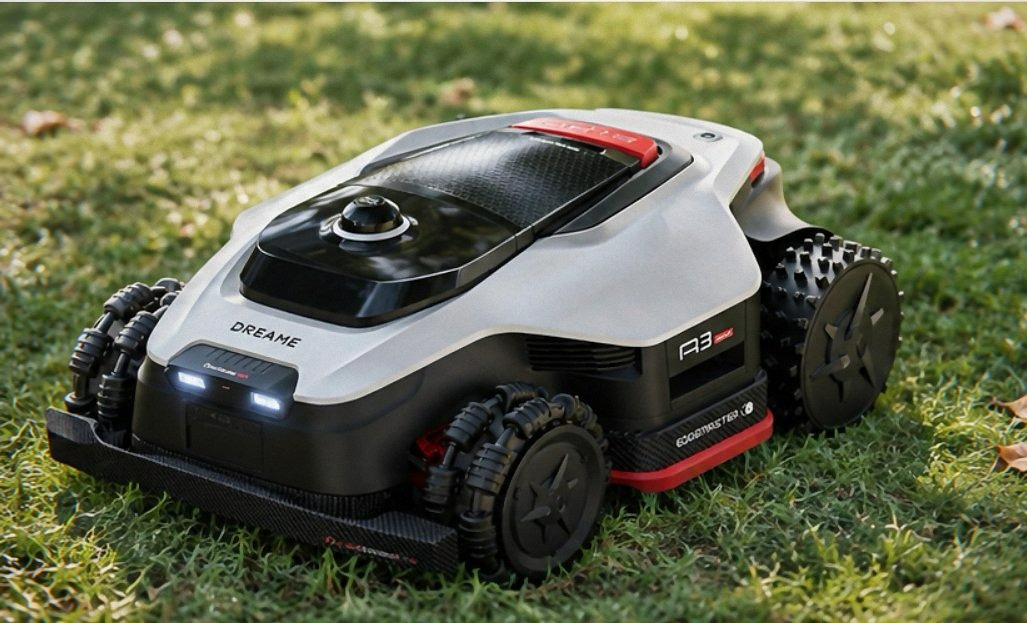
What the A3 AWD Pro 3500 actually is
This is Dreame’s flagship wire-free mower, rated for 0.87 acre. It weighs 26.4 lb — light for the category, which matters more than it sounds once you are the one carrying it up steps — and it is built from hard-anodized aluminum and stainless steel rather than the all-plastic housing common at this size. Medium gray is the only finish listed.
The cutting hardware is two floating discs rather than one, spanning a 15.8-inch width. Dreame claims Rush mode covers up to 8,611 sq ft per hour. Cutting height adjusts from 1 to 4 inches in one tap inside the Dreamehome app, and the deck is rated to chew through grass standing up to 8 inches tall.
That last figure deserves a second look, because it is where one of the loudest complaints lives. More on that below.
OmniSense 3.0, and what dropping RTK buys you
The navigation stack is 360° 3D LiDAR paired with binocular AI vision, marketed as OmniSense 3.0. Detection range is stated at 240 feet, and Dreame claims it identifies and avoids 300-plus obstacle types in real time without any wire in the ground.
The interesting claim is comparative: the listing directly contrasts this arrangement with RTK mowers that lose signal near trees, fences, or houses. That is a fair description of the failure mode, and it is the reason one reviewer’s experience reads the way it does. That owner came from a premium non-LiDAR, RTK-based machine on a property with raised garden beds, curved borders, mature trees, and a slope reaching about 25°. The old mower needed constant remapping, repeated no-go zone adjustments, and troubleshooting of positioning drift, and it still occasionally wandered into landscaping beds. With the Dreame, the same reviewer describes setup as straightforward and singles out not having to worry about satellite reception as the biggest improvement, along with edges being followed more accurately and far less manual correction afterward.
The theme breakdown on the listing points the same direction. Performance appears as a theme 10 times, navigation 6, and the auto-generated summary highlights buyers praising the navigation confidence — one noting how the LiDAR and vision handle obstacles, another reporting the yard mapped in roughly 15 minutes. Light on detail, but consistent with the written reviews.
Worth knowing: an owner who has lived with his for three months describes a learning curve, both to the menus and to the strategy behind mowing — how to zone the property, which direction to run, what height to set. His advice on overlap is the kind of thing no spec sheet carries. Where a sidewalk or driveway sits flush with the grass, he maps past the edge rather than up to it, because stopping at the edge leaves a thin strip that still needs a trimmer.
4WD, the 38.7° rating, and honest traction limits
Four hub motors drive all four wheels, and Dreame rates the climb at 38.7°, which is the same angle expressed as 80%. The wheels are described as heavy-duty off-road units intended to hold grip in thick grass and damp conditions.
There is a pattern on this one that is almost too on-the-nose: the reviews read as a lineup of people who specifically bought this mower because their last one could not get up the hill. One owner in Michigan describes a genuine slope, not a gentle roll, and says every previous mower either slipped, stalled, or had to be pushed by hand; this one goes up it like it is flat, with no wheel spin, then turns itself around at the end of the row and comes back down. Another reviewer reports climbing hills and uneven patches without slipping and leaving consistent stripes. Still another moved up from a different brand and calls the AWD the standout of the whole machine.
So the drive is the least controversial part of this product. The direction advice from that three-month owner is worth repeating anyway: up, down, and diagonal runs across a hill work, horizontal passes across the face do not.
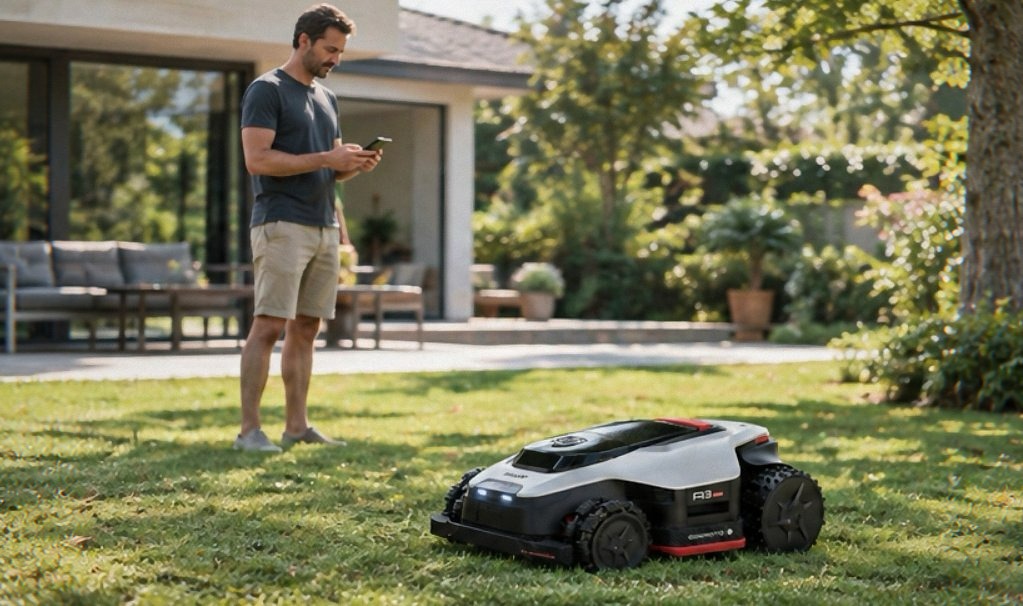
EdgeMaster 2.0 is the feature to think twice about
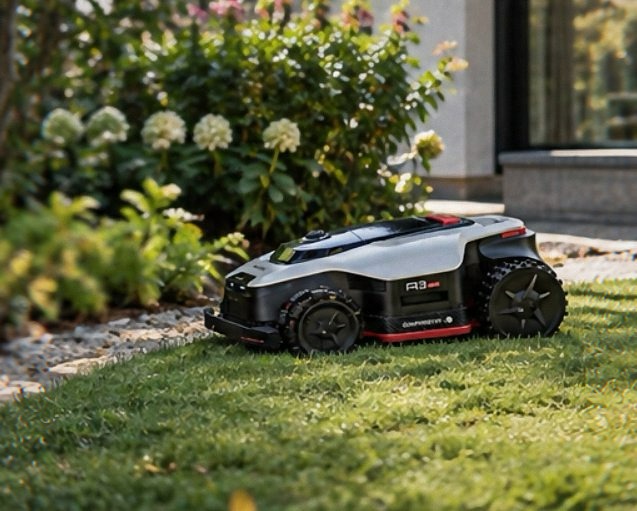
Dreame sells EdgeMaster 2.0 as cutting closer to borders and leaving almost no uncut strips, with edging advertised under 1.2 inches. On paper that is the feature that finally retires the trimmer.
One owner with three months of use says to leave it switched off. In his experience it scalps the edge — cutting into the turf rather than trimming alongside it — and it gets worse in a specific setup: when two grass areas are mapped as separate zones that meet back-to-back, the mower tears a strip along the shared boundary between the virtual zones. That is a detailed, falsifiable complaint from someone who kept the machine, and it is the sort of thing that matters more than a marketing number. The same reviewer also notes that no robot mower in this class is truly maintenance-free; a few edges still get trimmed by hand.
A second complaint about the cut quality comes from the harshest review on the page, and it is the one that explains the 11% one-star share. That buyer found the mower rolling over tall weeds and dandelions rather than cutting them, attributing it to the small blades having no lift, and describes the deck throwing cut grass out the back like a hay turner. Whether that reflects the machine or the mowing height he chose, the observation lines up with the physics of a lightweight floating deck — it cuts cleanly at the right height and struggles when asked to take down overgrown material. Which is precisely what the 8-inch maximum claims to handle.
Mapping, zones, and the remap problem
Here is where the 11% starts to make sense as a group rather than an outlier.
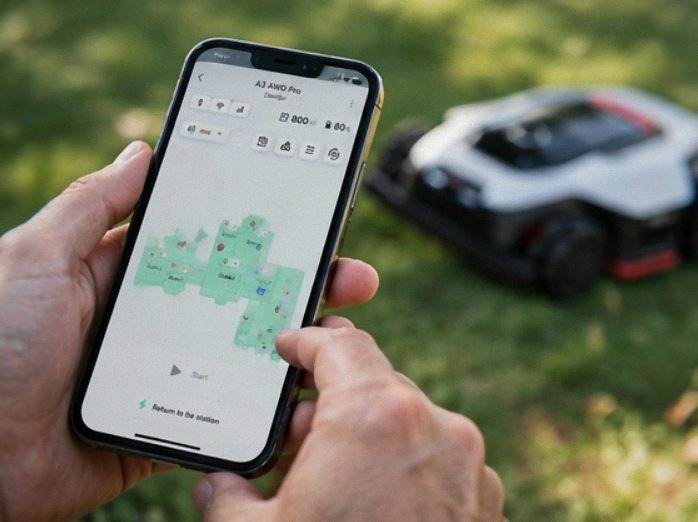
The same reviewer who returned his machine describes the setup as nightmarish on a real lawn — trees, shrubbery, weeds, irregular perimeters, uneven ground — and says the mowing that followed was just as disappointing. His breaking point was not the cutting at all. It was discovering that the app offered no way to edit the perimeter or the no-go areas he had already mapped. The only path forward was to start over from nothing and spend more hours driving the mower in learning mode, steering it through the app.
That is not a minor omission. Every other mower in this price band lets you nudge a boundary. If the app genuinely cannot, then a small mapping mistake is expensive in time, and that is a design decision rather than a defect.
Set that against the mapping capacity, which is where the listing contradicts itself. One section advertises 100 zones, 100 no-go areas, and 50 paths. Another part of the same page, and the product title itself, says 250 zones. Those are not the same promise. If you are mapping a complex property and zoning is central to how you use the machine, get clarity on which number applies before you buy — the difference between 100 and 250 is the difference between a yard that fits and one that runs out of slots.
The upside is that mapping capacity is generous in either reading. One owner had the yard mapped and mowing within about 15 minutes and set up his no-go zones without trouble, though he chose to map manually rather than trust the automatic pass, specifically to get coverage right up against the areas he cared about. Another who has run his for three months never uses “mow all” at once, instead mowing a few zones one day and the rest the next. That is a useful way to think about the machine: it is a zone tool, not a single-button lawn service.
Height, grass types, and mowing after dark
Height adjustment spans 1 to 4 inches, and the app lets you change it in a tap, which is more useful than it sounds if you run different heights on different zones or shift with the seasons. One owner cutting Bermuda says the mower genuinely made his uneven areas look less noticeable, which is a reasonable thing to expect from a lightweight deck on a lawn that is not flat.
Night mowing is a real feature here rather than a spec-sheet line. Dreame describes the operation as quiet enough to run after dark without disturbing the house or the neighbors, with scheduling handled in the app and built-in LED lighting so the machine can work after sunset. One reviewer describes the sound as a steady hum — not loud, but clearly a motor working hard, which is a fair characterization of the load when the deck is cutting two discs of grass at speed.
Security and tracking
Theft protection is 24/7 yard monitoring with human detection alerts, plus GPS and 4G tracking through the app so the mower’s location stays visible. There is also a real-time notification stream. If you have ever walked outside at night to confirm the machine was still on the property, this is the answer to that, and on a machine at this price it is not a decorative feature.
What the 117 ratings actually say
The praise is consistent and narrow: performance first, navigation second. The written reviews that rate it well describe wide coverage from the twin discs, enough battery to finish front and back on a single charge, confident obstacle handling around raised beds and landscaping, and a drive system that does not slip where previous mowers did.
The criticism is equally consistent, and it is not about the hardware. It is about setup time on messier properties, the lack of in-app map editing, aggressive edging behavior, and cut quality on overgrown grass. Those are software and tuning complaints, which is why this machine reads like a good robot with a couple of unfinished corners rather than a bad product.
Running through the links here may earn a small commission, at no extra cost to you.
Price, siblings, and the buyers this fits
There is an annoyance before you even get to the number: the listing hides the price behind the cart, showing only that a coupon applies. The same model surfaces elsewhere in the page’s own recommendation blocks in the high $1,000s against a list price nearer $2,700, and the smaller A3 AWD Pro 2500 — 0.62 acre instead of 0.87 — is listed noticeably cheaper. Dreame also sells a quick-release blade kit as a companion, which is the wear part to budget for over time. Amazon offers a $299 professional installation that excludes removing your old mower and any electrical work; on a wire-free machine the only real labor is a mapping walk, so that fee is easy to decline.
For a direct read on the size step-up, our Mammotion LUBA 3 AWD 3000H review covers the larger mower from the other camp, and the Mammotion hub article is a useful orientation if you are weighing the whole LUBA range against this. The picture of what a wire-guided machine buys you instead is in our WORX Landroid L WR155E review, and the STIHL robot mower write-up makes the same point about mechanical basics deciding ownership. If the yard is flat and simple, our Sunseeker robot mower piece is the honest budget comparison, and for a category-level view of where these machines are heading, the Segway X430 vs Ecovacs A3000 comparison is worth ten minutes.
Read the whole thing together and the fit is specific rather than universal. Buy this if you have slopes a wheeled mower cannot climb, a yard with no viable RTK placement, or an HOA deadline you miss every week — and if you accept that the first two or three mows are spent learning the machine rather than watching it. Skip it, or at least wait for the map-editing question to have a clear answer, if you are an early adopter who cannot tolerate remapping an entire zone to move one boundary. And if your lawn is a flat rectangle, none of what this machine is good at will ever switch on.