The string trimmer died on a Saturday in late July. Mid-ditch, naturally. I was ankle-deep in the swale behind the garage, the one that’s basically a 35-degree slip-and-slide after any rain, pulling the starter cord on a gas trimmer that had decided it was done with me personally. Third pull. Fifth. Twelfth. My neighbor watched from his deck with a beer. Didn’t offer to help. Just watched, the way you watch a nature documentary about a dumb animal.
I went inside, sat on the kitchen floor because the chairs felt too far away, and ordered the Mammotion LUBA 3 AWD 3000H on my phone while my socks were still wet.
That was the headspace. Keep it in mind.
Why this one and not the fifty others
I’ve been down this road. If you’ve read my robot lawn mower buying guide for 2026, you know I’ve got a whole cemetery of half-dead mowing gadgets in the shed. Boundary wire bots that needed a funeral for a wire every time the aerator came through. A GPS unit that got confused by my own maple tree and just… sat there, blinking, like it was reconsidering its life.
The LUBA 3 AWD 3000H caught me for a specific reason: no perimeter wire, no RTK antenna sticking out of my lawn like a lawn dart, and it’s rated for 80% slopes. That’s 38.6 degrees. My swale is steep enough that I’ve slid down it on my butt twice, and both times I was sober.
Also it’s the “H” version. Cutting height from 2.2 to 4.0 inches. I keep my fescue tall because scalped grass in August is just a dirt announcement. The standard S version cuts lower, if you’re into the golf-course look and enjoy stress.
The box, the dock, the first hour
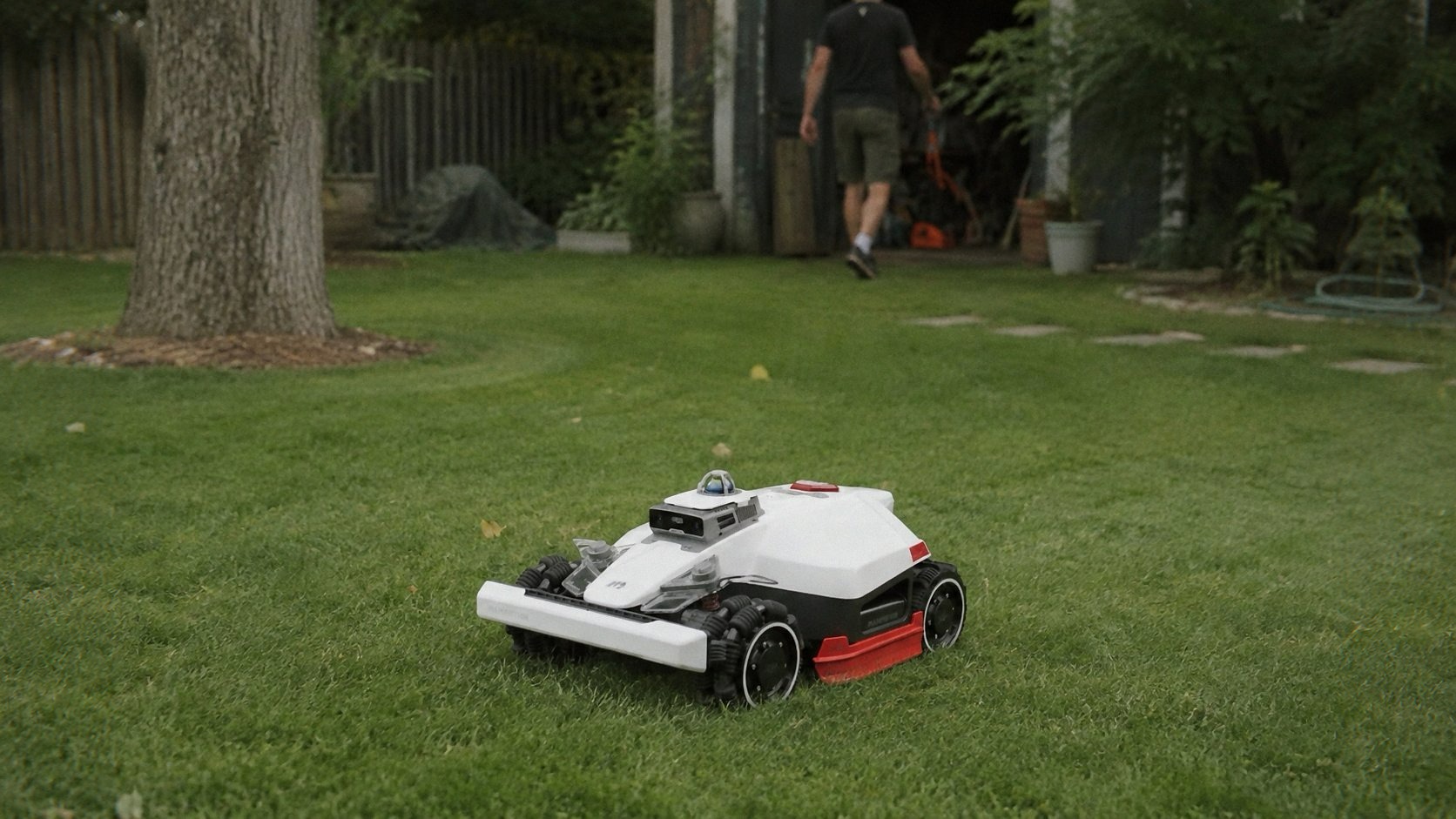
The box is enormous. Absurdly so. It sat on my porch for an hour while I walked around it twice, suspicious, the way you’d circle a piece of furniture left on a curb. Inside, though, the mower is basically assembled. You clip on the front and side bumpers — there’s a specific chunky thunk when each one seats, a deeply satisfying sound, like closing the door of a car that costs more than your car — drop in the security key, and that’s it. No tools. I had mentally budgeted a whole evening and a six-pack for setup, and instead I was done in twenty minutes, standing in the garage holding a beer I no longer had a reason to stress-drink.
Setting up the charging dock took longer than setting up the mower. Not because it’s hard. Because I overthought the placement for forty-five minutes like it was a chess move. Flat spot, near an outlet, clear path in front. Fine.
One thing nobody tells you: this thing is 41 pounds, and carrying it by the handle feels exactly like carrying a car battery that judges you. The rubber on the tires has this aggressive tread that leaves a faint rubber smell on your hands. First-week smell. It fades.
The navigation thing, because it’s the whole point
Tri-Fusion Positioning. Mammotion’s phrase. It’s 360° LiDAR plus NetRTK plus dual-camera AI vision, three systems cross-checking each other so the mower knows where it is down to about a centimeter. I went deep on the nerd version of this in my RTK vs LiDAR breakdown, so I won’t re-lecture. Short version: LiDAR doesn’t care about tree cover, NetRTK doesn’t care about your LiDAR’s bad day, and the cameras handle the “that’s a dog toy, not a rock” decisions.
Here’s what that means in a real yard. My property has a maple. A big one. The kind of canopy that turned my old RTK-dependent bot into a lawn ornament. The LUBA 3 rolled under that maple on day one, did its little scan, and just… kept mowing. In the shade. Under branches. No antenna drama, no signal loss tantrum.
The mapping run was almost boring, which is the highest praise I have. I drove it around the perimeter with the app like a very slow RC car, it built a 3D map, I split the yard into zones — front, back, the ditch of shame, the strip by the fence that I’ve pretended doesn’t exist since 2022. It handles up to 30 zones. I have five. It judged me silently.
Compared to the Ecovacs Goat A3000 LiDAR Pro I tested earlier this year — which is a genuinely good machine, don’t get me wrong — the LUBA felt less precious about terrain. The Goat is a ballerina. The LUBA is a hiking boot.
Slopes. The part you actually came here for.
My backyard drops off at an angle I have never measured because measuring it would make it real. The LUBA’s AWD — four wheels, all driven, with what Mammotion calls adaptive suspension — went down that slope, turned around at the bottom, and climbed back up. First try. No wheel spin. No sad beeping.
I stood there with my arms crossed waiting for it to fail, and it declined to. Rude, honestly.
It’ll step over roots and curbs up to about two inches. There’s a raised root near the shed that’s eaten two mower blades and one of my shins over the years. The LUBA bumped it, rocked over it with this weird deliberate lurch like a guy stepping over a puddle, and kept its line. I’ve watched it do that maybe a dozen times now and I still don’t fully trust it, the way you don’t trust a cat near a full glass of water.
Mowing speed is rated at 5,400 square feet per hour with a 15.7-inch cutting width — dual discs, six pivoting razor blades each. In practice my yard takes it about two sessions with a recharge in between. It goes back to the dock, charges for a couple hours, then trundles back out and resumes where it left off. The dock light, by the way, pulses this soft green while charging and stays lit for a good while after the mower leaves. Found that out at 1 a.m. through the kitchen window. Thought something was on fire. It was not on fire.
The app, the AI, and my dog’s opinion
The app is fine. Better than fine, actually — zone editing is drag-and-drop, schedules are simple, you can set different cutting heights per zone, which I did because the front lawn is for show and the back lawn is for survival. No-go zones took me thirty seconds to draw around the garden bed my wife threatened me about.
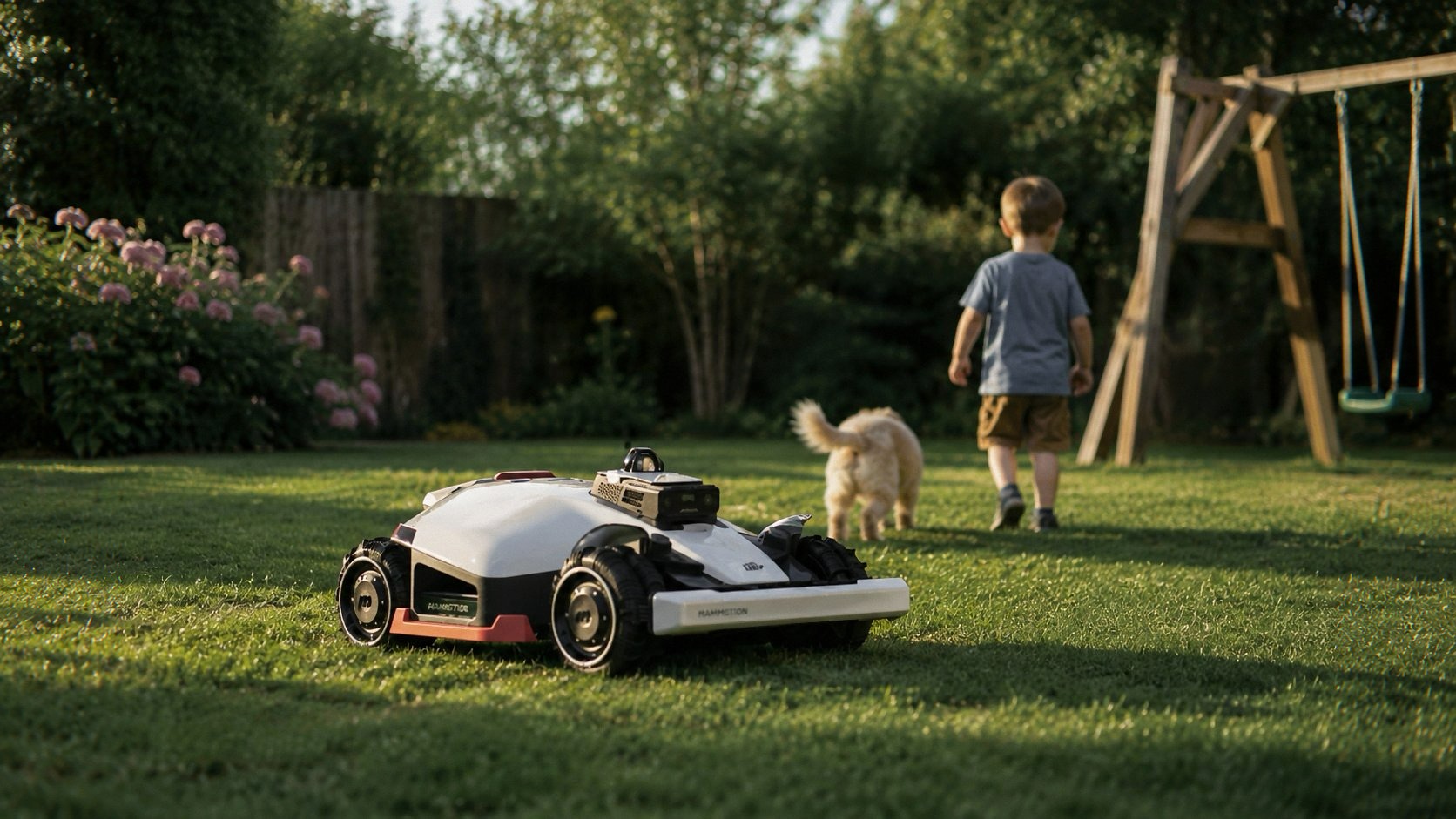
Obstacle avoidance recognizes 300+ object types. What I can confirm: it avoided my dog, a soccer ball, a garden hose I forgot about, and one extremely confused toad. The dog, for his part, followed it around for two days, then decided it was boring and now ignores it completely. The toad moved. Eventually.
There’s a 4G module with three years of data included, plus Wi-Fi and Bluetooth. Theft protection with GPS tracking, which matters, because a $2,799 robot driving itself around your front yard is, let’s say, a tempting target for the entrepreneurial criminal. If someone picks it up, you get an alert and a location. I tested this by picking it up myself and felt briefly like a thief in my own driveway.
If you grab one through the links here, I might get a small cut — costs you nothing extra and keeps the lights on.
How it actually cuts
Checkerboard pattern. Neat rows. Edges surprisingly tight — there’s a smaller edge-cutting disc that gets within a respectable distance of the fence line, though “respectable” is doing some work in that sentence and I’ll come back to it.
The cut quality itself is good. Mulching-style, tiny clippings, no clumps. After three weeks the lawn has that even, slightly striped look that makes the neighbors think I’ve become a different person. I have not become a different person. I was sitting inside eating chips while it did that.
Runtime per charge is around 175 minutes on the 12Ah battery in the 3000H. Roughly 0.2 acres per charge, 0.75 acre max total coverage. If you’ve got more lawn than that, look at the 5000H, or reconsider your life choices, or both. The Mova Lidax Ultra 2000 covers similar ground and is worth a look if you’re cross-shopping — I compared notes on both and the LUBA wins on slopes, the Mova on price.
The downsides, because I’m not a brochure
Alright. The list.
Price. $2,799 list. That’s a motorcycle. That’s a semester of community college. It’s cheaper than the Husqvarna Automower 410 iQ I grumbled about, and it out-climbs it, but still. This is real money and you should feel the weight of it.
Edges. The edge disc gets close to borders but not on them. You’ll still need a trimmer pass every couple of weeks along fences and beds. Which means my dead trimmer’s replacement is still in my future, and my future self is annoyed about it.
The manual. Reads like it was translated twice, once by a human and once by a fax machine. The app walkthrough carries the setup, thank god, because the printed quick-start guide includes a diagram I’m fairly sure is for a different product.
Rain logic. It handles dew and light drizzle fine — IPX6, sealed electronics, all that — but wet grass on a steep slope is wet grass on a steep slope. After a heavy storm I keep it parked for a day. The traction is impressive, not magical. Physics still works here.
Noise at the dock. Not mowing noise — it’s quiet mowing, quieter than the Mowrator S1 remote-control unit I messed with this spring. But when it backs into the dock there’s a sequence of beeps and mechanical clunks that, at 6 a.m. on a Sunday, is louder than you’d like. Move the dock away from bedroom windows. Learn from me.
Three weeks in
The lawn looks better than it has since I moved in. My weekends are mine again. The ditch of shame is just… the ditch now. I sat on the deck last Saturday — same neighbor, same beer, reversed roles — and watched a robot climb a hill I used to curse on.
It’s not perfect. It’s not cheap. The edge thing will bug you if you’re a completionist, and the manual will bug you if you’re literate. But it mows a yard I was genuinely afraid of, wire-free, under trees, on slopes, without me. That’s the whole job. It does the whole job.
The grass behind the garage got cut today while I wrote this. Coffee’s cold. Dog’s asleep. The trimmer’s still dead in the shed and honestly it can stay there a while longer, I’ve made my peace with