Skipping the boundary wire has never been the cheap option. The machines that do it well have mostly sat well north of a thousand dollars, which is a hard sell if your lawn is a quarter of an acre and a corded model would do fine. The ANTHBOT M5 LIDAR is aimed squarely at that gap. It lists at $899, skips the wire, and skips the RTK antenna too, leaning on LiDAR and two cameras instead.
The catch is written into the product name: 1/8 acre. Everything about this mower — its weight, its runtime, its cutting deck — is sized for a lawn that small, and most of the complaints in its 367 ratings come from buyers who treated it as something bigger.
What $899 is actually buying
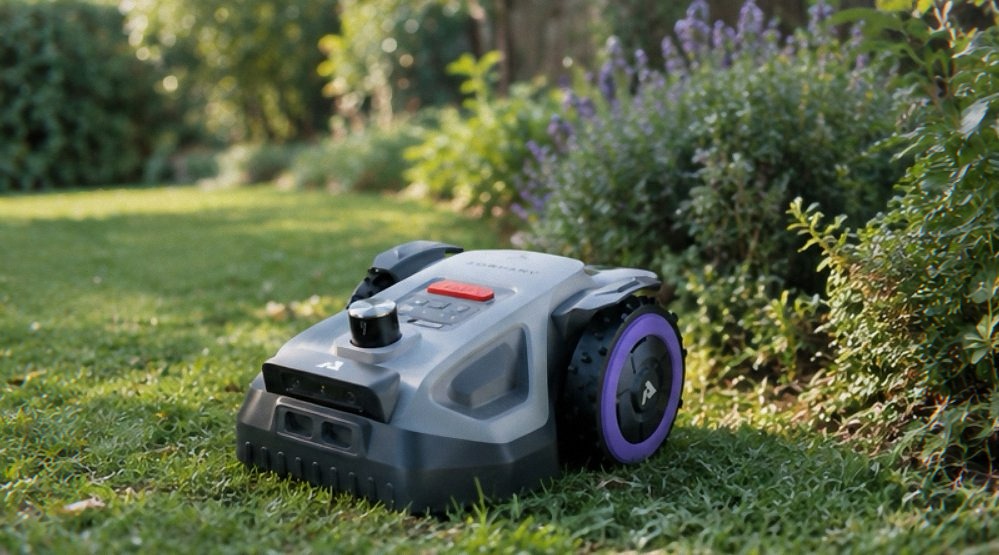
The M5 LIDAR is a 21.6-pound aluminum-bodied mower rated for 1/8 acre. That weight is the first thing to appreciate if you have ever moved a full-size robot mower; at 21.6 pounds it is a one-hand lift rather than a two-person job, which matters if the machine has to move between a front and back yard or come inside for winter.
The build is aluminum, the finish is gray, and the package is deliberately sparse — a charging station and the mower, with a garage sold separately at $169 if you want the dock covered. The price sits far below the wire-free LiDAR machines from Dreame and Mammotion, and the honest question is what got cut to get there. The answer shows up in the cutting hardware and the battery, not the navigation.
LiDAR’s real advantage: enclosed yards
The pitch here is not that LiDAR is better in the abstract. It is that LiDAR does not care about the sky. The M5 scans with a 360° laser radar and never leans on satellites, so walls, dense trees, and narrow gaps between buildings — the exact conditions that make RTK mowers lose their fix — simply do not register as a problem. ANTHBOT’s own framing is that the more enclosed your yard, the easier this gets, which is the reverse of how satellite-based mowing behaves.
That is the strongest technical argument in the whole listing, and it lines up with what buyers describe. One owner who runs his three times a week calls it a great little mower for a small yard. Another describes setting up boundaries around a front lawn divided by a path, worrying about how the mower would handle the crossing, then finding the zones fell into place on their own. A different reviewer who had never owned an automatic mower before says the setup surprised him — he expected trouble and got a machine that mapped his split lawn without a fight. The auto-mapping and the zone logic are the parts that most consistently earn praise.
ANTHBOT claims full readiness three minutes after unboxing, which is marketing arithmetic rather than an experience anyone describes. What owners actually report is closer to a short afternoon: charge the machine, walk the boundary, then accept that the first pass or two are for learning.
The slope rating is more modest than it reads
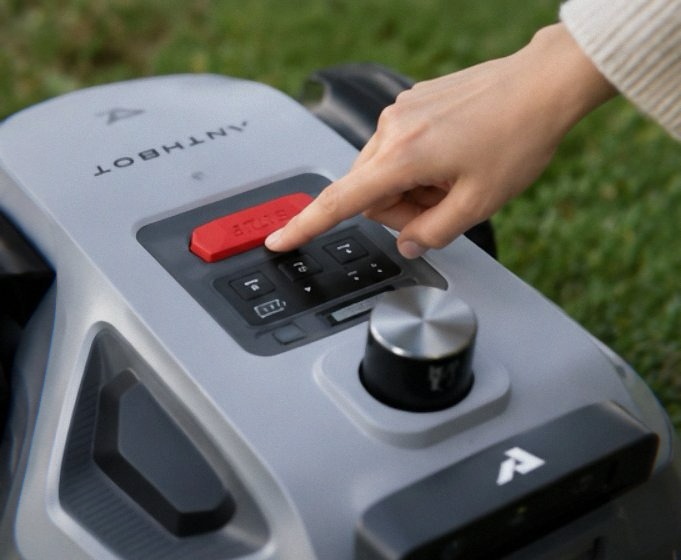
The title says 45% slope. The body copy says 24°. Those are the same number, since a 45% grade works out to roughly 24 degrees, and the twin phrasing makes it look like two separate capabilities. Either way, it is worth sitting with what that means in context: this is a modest incline rating, well short of the steep-slope machines that claim 80% and market themselves on climbing ability.
That is not a flaw so much as a category line. The M5 uses dual-wheel drive rather than all-wheel drive, which is a deliberate choice for a light mower on small lawns, and ANTHBOT positions the gear-tread tires as gripping firmly and self-recovering when they slip. One owner with a couple of side-yard slopes reports it does a nice job on them. Another who has used his for a while says it handles his slopes without issues. Nobody in these ratings is asking the M5 to conquer a hillside, and that is the right way to read it. For a real grade, the Mammotion LUBA 3 AWD 3000H is the machine designed for it.
Runtime is where the marketing and the reviews part ways
The listing says each charge delivers 40 minutes on flat turf, and that a single day’s work covers 500 m² — about 5,400 sq ft, or just under the rated 1/8 acre.
The sharpest review on the page disagrees. That owner reports roughly an hour of battery life and says the machine was essentially depleted after 80 m², roughly a tenth of the daily figure ANTHBOT advertises. He notes it returns to the charger and carries on afterward, which softens the failure into an inconvenience rather than a breakdown — but a tenfold gap between the claim and a buyer’s own tally is the kind of thing you want to see before ordering, not after.
There is a second, gentler version of the same story. One owner found that a single full charge covered the mapping run plus one complete zone, and that a zone took about an hour — longer than mowing it himself, but hands-off time he could spend elsewhere. Read together, the picture is a mower whose real per-charge coverage depends heavily on grass density and slope, and whose auto-resume behavior is what keeps that from becoming a daily problem. Buyers considering the machine mainly for that resume feature are chasing the right advantage.
A narrow deck behind a wide-swath claim
The deck measures 200 mm. That is about 7.9 inches of cut per pass, which is not wide in a category where dual-disc machines are pushing past 15 inches. The listing calls it a widened deck with five sharp blades and U-shaped path planning to make up the difference, and to be fair, five blades on a narrow footprint is a reasonable way to keep the cut clean on a small lawn. It is also the reason the machine is slow: an owner with an M5+4G says plainly that it does the job but is rather slow, and recommends it for a small area. He is right, and the deck is the reason.
 Where the narrow cut does pay off is along edges. Buyers describe it covering the borders and working smoothly around an obstacle sitting in the middle of the grass — one mentions a plumbing outlet — and the German-language review notes a reliable rain sensor and dependably detected obstacles, with only a narrow strip left at the edges that he finishes with a trimmer. That leftover strip is the normal outcome for this class of mower, not a defect, and it is the same mild compromise noted in our STIHL robot mower write-up.
Cutting height runs from 1.2 to 2.8 inches across nine levels, adjustable in the app without tools. On a small, well-kept lawn that range is fine. It is not built to knock down an overgrown yard, and one owner with a garage bundle says exactly that — it will not tackle an overgrown lawn, but it keeps one looking crisp.
Setup, the charging pad, and the map you cannot edit
The recurring frustration in these ratings is not the cutting. It is the software.
One owner with an M5+Garage calls the app a mess and lists the specific gaps. The machine is not good at sensing objects even at the highest vision sensitivity, and it gets stuck on things. It leaves random long blades scattered through the yard. But the complaint that reads as decisive is about the map: you cannot edit anything on the existing map without physically driving the mower around the area you want to change. Expanding the map requires driving a closed loop that ends where it started, and he says it sometimes fails to register the loop even when he is certain the lines crossed.
That is the same limitation buyers hit on the Dreame A3, and it is the same design decision underneath: the map is only as good as the first walk, and correcting it costs as much time as making it. One owner who has used his for a while takes a kinder view, saying the app is straightforward for creating zones and adjusting schedules. Which experience you get depends on how much your lawn needs fixing after the first attempt.
Two practical notes from the reviews are worth keeping. The first is charging-station placement: the mower needs clear room around the pad to line up and dock for charging, and a buyer who got that wrong reports charging takes a couple of hours. The second is the garage accessory. More than one owner ordered the bundle with the garage and had it arrive late or not at all before a follow-up sorted it out, which turned an easy purchase into a support ticket.
What 367 ratings add up to
The spread is 4.3 overall, with 61% five-star and 21% four-star — a distribution that looks like a product people broadly like, with a smaller tail of real dissatisfaction at 5% one-star and 3% two-star. The listed themes put setup at 10 mentions, effectiveness at 15, battery life at 6, and value for money at 5. Value appearing that high is unusual in this category and it tells you what buyers think they got.
The praise clusters around the same few things: it is easy to set up for a wire-free machine, it handles a small lawn on a schedule without babysitting, and it costs less than the alternatives. The criticism clusters just as tightly: it is slow, the app needs work, it gets stuck on things it should avoid, and the battery does not deliver what the listing promises.
One genuine bright spot is support. An owner whose first unit shipped with Wi-Fi and charging faults describes ANTHBOT troubleshooting through the Amazon account and then swapping the device directly, with the replacement working fine — and calls the support outstanding. For a brand-new name at this price, that is worth more than a spec bump.
Links in this piece may earn a small commission, and it does not change what you pay.
Sizing the decision
If your lawn is genuinely around an eighth of an acre, sheltered by walls or trees, and you want to stop pushing a mower without spending two thousand dollars, this is close to the only product making that offer — and our Sunseeker robot mower piece covers the other budget-leaning option if you are still weighing which way to go.
If your property is larger, sloped, or messy with obstacles, the arithmetic inverts fast. You would be paying for navigation capability and then fighting a narrow deck, a short runtime, and an app that will not let you fix a map without re-walking it. The case for spending more on a bigger machine is strongest exactly where this mower stops being useful, and the range of options at the steep end is covered in our LUBA lineup overview.
The wire-free-versus-wire tradeoff still exists at this price, though. If you are comparing the M5 against a cheaper machine that buries a cable, our WORX Landroid L WR155E review is the honest read on what the wire buys you in exchange for the labor. And the broader question of how quickly these categories are blurring is one our Segway X430 vs Ecovacs A3000 comparison treats at length.
A quarter-acre lawn on flat ground does not need LiDAR, does not need wire-free navigation, and does not need this mower. A small enclosed yard that has defeated an RTK machine might.