So you’ve got a bigger yard. Not the tidy suburban quarter-acre where a cheaper bot would do the job — we’re talking 2000 square meters, real slope to deal with, a lawn that eats whole weekends. That’s exactly what the WORX Landroid L WR155E was built for.
I’ve spent a lot of time digging through robot mowers lately, and the WR155E is one of the more interesting options in the large-garden segment. Not cheap — over $1,300 — but it handles terrain that would make most budget bots quit. Here’s the full picture, including one thing US buyers need to know before they hit “buy.”
WR155E Specs: What You’re Actually Getting
Start with the numbers — they tell most of the story on this model.
| Spec | WR155E |
|---|---|
| Coverage | Up to 2000 m² (approx. 21,500 sq ft / 0.5 acre) |
| Cutting Width | 220 mm (8.7 inches) |
| Cutting Height | 30–60 mm (1.2”–2.4”) |
| Max Slope | 35% gradient |
| Battery | 20V / 5000 mAh lithium-ion |
| Battery Runtime | 120 minutes per charge |
| Navigation | Boundary wire + AIA Agile Technology |
| App Control | Yes — WiFi, iOS and Android |
| Voice Control | Alexa and Google Assistant compatible |
| Anti-Theft | PIN code protection |
| Weight | 20.5 kg (45 lbs) |
| Price | ~$1,316 |
Two specs separate this from the smaller Landroid models: slope rating and battery. 35% gradient is genuinely serious — roughly 19 degrees, steeper than most suburban lots and competitive with dedicated all-terrain machines. 120 minutes per charge means it covers real ground before heading back to base.
The 220mm cutting width — wider than the WR147’s 7-inch disc — also means more coverage per pass, which matters once a property gets large.
The Critical Warning for US Buyers
Putting this up top because it matters, and too many people find out after they’ve already paid.
The WR155E is a European-market model. One verified US buyer put it bluntly: Amazon doesn’t stock replacement batteries for this model in the US. Battery dies down the road, you’re stuck. On a $1,300+ purchase, that’s not a small problem.
What this means practically:
- The mower itself runs fine in the US on standard 20V operation
- WORX Power Share batteries from US-market WORX tools are NOT cross-compatible with the WR155E (different battery specs — 5000mAh 20V European variant)
- A replacement battery means importing from Europe — expensive, slow
If you’re in the US and want this level of large-garden coverage, look at the US-market WR155 instead — it runs on standard WORX Power Share batteries you can actually buy domestically. The WR155E covered here fits European buyers who already know they need 2000m² coverage.
If you’re in Europe, Canada, or anywhere with regional access to WORX’s European line, none of this applies to you.
Setup and Installation: The First 48 Hours
Installation runs on the same boundary wire system as every other Landroid. Stake a perimeter wire around your mowing zone, connect it to the charging base, and the WR155E uses it to define its working area and find its way home.
For a 2000m² garden, this isn’t a quick afternoon job. The box ships with 250 meters of boundary wire and 340 pegs — a lot of wire to lay, and it takes time to do properly. Plan for a full day if your garden has any complexity at all: flower beds, trees, garden borders, separate zones.
One WR155E owner in Germany documented the first few days well: day one was slow, mostly following the mower around fixing stuck points. Day two, one incident. Day three onward, smooth. That trajectory is typical on larger installs where the first wire placement isn’t perfect and needs adjusting.
The 11-Inch Rule (Same as Every Landroid)
If you’ve read our [WORX Landroid M WR147 review], you already know the core principle: keep the boundary wire at least 10-11 inches from any obstacle, edge, border, or hard surface. The Landroid navigates home by centering on the wire. Too little clearance and it can’t maneuver — it gets stuck.
Same rule applies here. More borders and obstacles on a larger property just means more time getting it right. Once it’s right, the mower runs on its own.
How the AIA Agile Navigation Works on Large Gardens
The WR155E runs WORX’s AIA (Artificial Intelligence Algorithm) navigation, same system across the whole Landroid range. Looks random, but statistically covers the entire lawn through repeated cycles.
On a 2000m² property this plays out differently than on a small lot. A single 120-minute charge won’t cover the whole garden — the mower heads back to base, recharges, goes back out to finish the job. Smart Auto Scheduling in the app works out how often it needs to run to keep your specific lawn maintained and sets that schedule automatically.
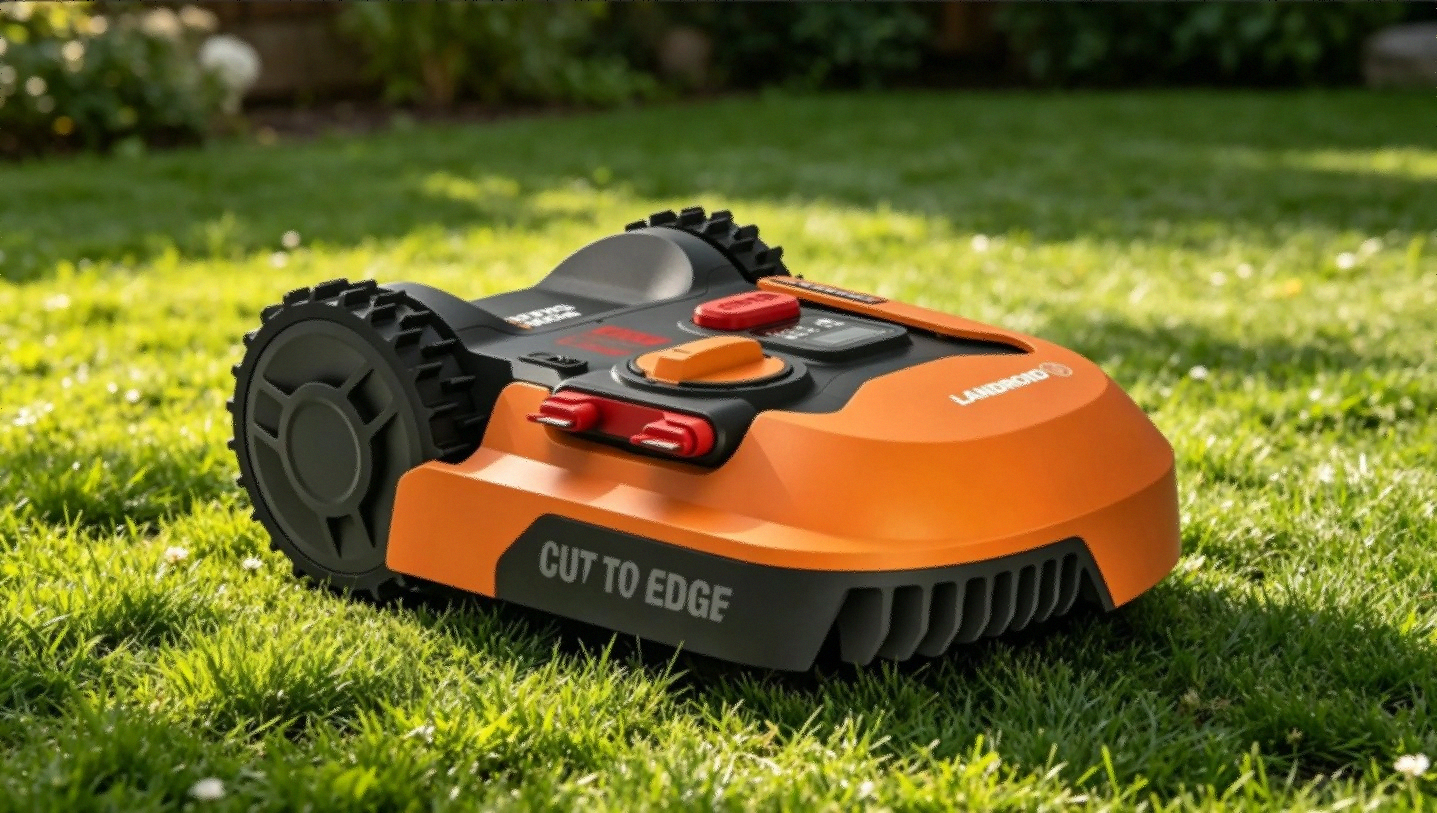
AIA also includes cut-to-edge capability — the blade disc offset lets it cut right to the perimeter, which means less manual trimming along fences and borders. On large gardens with long perimeters, that adds up.
For slopes, independent brushless motors on each wheel give the WR155E real grip on gradients. At 35% max slope handling, it beats most robotic mowers in its class. One Italian owner running it on a 2000-2500m² garden said it handles slopes and corners well, though blades need inspecting every 50-80 hours since grass residue clogs them over time.
Real Performance Across Different Lawn Types
What It Does Well
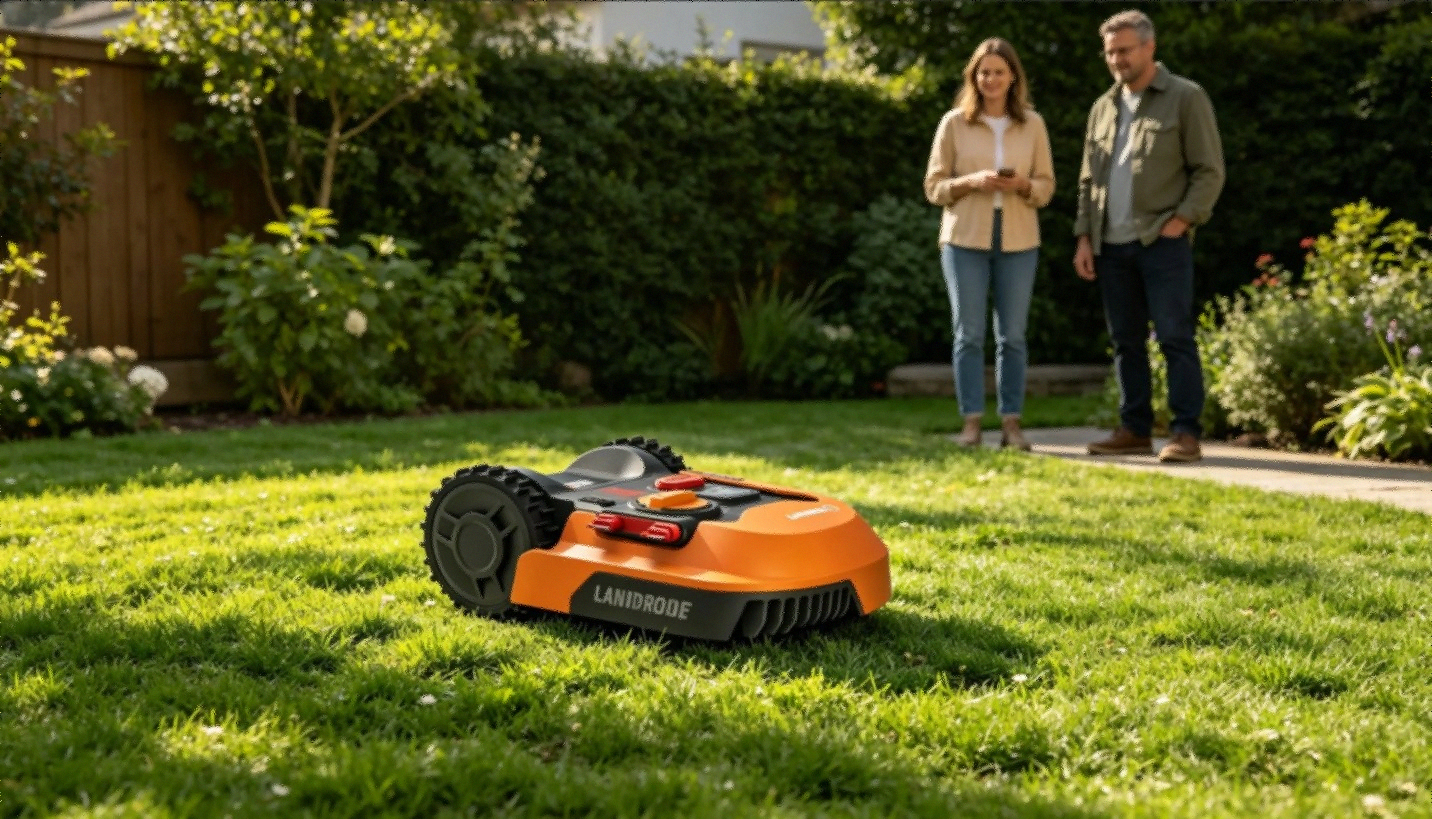
Large flat-to-moderate-slope gardens. Native habitat. Set the schedule, let it work. Owners in Germany, Spain, and Canada consistently report good results on standard grass once setup is dialed in.
Steep gradient sections. The 35% slope rating isn’t marketing fluff. The independent motor drivetrain gives it real traction on inclines where lower-spec robots stall or slip. A garden with a bank or sloped section is exactly where this machine separates itself.
Edge coverage. Cut-to-edge performs better than expected. The offset blade geometry gets noticeably closer to garden borders than center-blade designs, cutting down on hand trimming after each cycle.
Quiet operation. Like every electric robotic mower, it’s genuinely quiet. Run it while people are out in the garden, having a conversation nearby, or early in the morning — nobody notices.
Long-term economics on large gardens. Professional lawn care for a 2000m² garden isn’t cheap. Even at $1,300+, the WR155E pays itself back within 1-2 seasons for anyone currently paying for regular professional mowing.
Where It Struggles
Sensor issues after extended use. A Swedish owner reported the lift sensor failing after three weeks — the mower behaved as if it was constantly being lifted and refused to operate. Four contacts with support later, still unresolved. Seems like an edge case, but worth flagging. Support responsiveness appears to vary by region.
USB firmware updates. The WR155E needs a USB drive to update firmware or pull log files for troubleshooting. Mildly annoying next to the over-the-air updates some competitors offer.
Gardens with heavy debris. Like all rotary robotic mowers, it doesn’t like acorns, pine cones, or similar debris. Heavy tree coverage means clearing the lawn before runs during the season it sheds.
Very long wet grass. Built for frequent maintenance cuts, not recovery mowing. Neglected garden with grass over 4-5cm means multiple passes and dropped performance. Better to run it consistently so it’s always doing light maintenance instead of catching up.
WR155E vs Competing Large-Garden Robot Mowers
The WR155E competes in a segment that now includes some strong wire-free alternatives.
WR155E vs WORX Landroid Vision (1/2 Acre, $999)
The Landroid Vision is WORX’s own newer wire-free model, using AI camera-based obstacle avoidance with no boundary wire. $300 cheaper than the WR155E, similar coverage. Tradeoff: Vision tech is newer, behaves differently in shade and complex lighting, and needs a different setup approach. Staying in the WORX ecosystem but want wire-free? The Vision series deserves a look. More on this in our RTK vs LiDAR robot mower comparison.
WR155E vs ECOVACS Goat A3000 LiDAR PRO (~$999)
The Goat A3000 LiDAR PRO uses LiDAR mapping for wire-free navigation and covers up to 1 acre. Usually comes in under $1,000 — notably less than the WR155E — with a more modern navigation approach. Worth comparing if you’re comfortable with newer tech and have the budget. Full breakdown in our ECOVACS Goat A3000 LiDAR Pro review.
WR155E vs Segway Navimow X430
The Navimow X430 is Segway’s large-garden wire-free model running RTK+Vision navigation. Premium pricing, premium accuracy. If slope handling and large-area coverage top your list and budget isn’t the constraint, the X430 is the one to compare against. Our Segway Navimow X430 review goes deep on real-world performance. ECOVACS WINBOT W2S Omni
Where the WR155E Holds Its Ground
Despite the wire-free competition, the WR155E has real advantages: proven boundary-wire reliability on complex terrain, a 35% slope rating most competitors don’t match, and 120 minutes of genuine runtime per charge. On gardens with significant slope where GPS or vision navigation tends to struggle, boundary wire is more predictable.
The WR155E Accessory Ecosystem
WORX has built out accessories for the Landroid L that address real limitations.
Anti-Collision System (ACS): Adds ultrasonic sensing 5 inches ahead and 8 inches in front, letting the mower detect and steer around obstacles before contact. One German owner bought ACS before first use and called it essential for their garden’s complexity.
Off-Road Tyres: WORX makes terrain-specific tyres for the WR155E, for gardens with tougher ground conditions. The same German owner fitted these for their 2000m² garden — useful on uneven or softer ground.
Find My Landroid GPS: Anti-theft cellular tracking. At $1,300+, a fair insurance consideration. PIN code comes standard; GPS is the paid add-on.
Radio Link Wi-Fi Extender: Worth it if your garden extends past your router’s range — common on 2000m² properties.
Garage/Shelter: Protects the charging station from heavy rain and UV over time. Optional, but extends the equipment’s life.
What’s In the Box
For $1,316 you get a complete kit — nothing extra needed to get started:
- 1x WORX WR155E Landroid robot
- 9x replacement blades and screws
- 1x 20V 5000mAh lithium-ion battery
- 1x charging station with power supply and mounting nails
- 1x 250m boundary wire
- 340x wire pegs
250m of wire and 340 pegs is a generous kit — enough to properly border a 2000m² garden with correct spacing, plus margin for mistakes and re-runs. You shouldn’t need to buy extra wire for a standard large-garden layout.
Voice Control and Smart Home Integration
The WR155E supports Alexa and Google Assistant — start mowing, stop mowing, check status by voice. If you’re already in either ecosystem, it’s a nice layer on top of app control. Not essential, but convenient.
WiFi app control lets you monitor mowing progress, adjust schedules, start or stop remotely, and get alerts if the mower gets stuck or needs attention.
Frequently Asked Questions About the WR155E
Does the WR155E require WiFi to work?
WiFi is needed for remote app control and software updates. The mower runs autonomously on its programmed schedule without it. Lose connectivity and it just continues the last schedule until you reconnect to make changes.
Can I get replacement batteries in the US?
This is the big issue for US buyers. Amazon US doesn’t stock replacement batteries for the WR155E (European model). US buyers should seriously consider the US-market WR155 instead, which runs on the standard WORX Power Share battery ecosystem.
How does it handle the 35% slope?
Independent brushless motors on each wheel provide the traction for steep gradients. On genuinely steep sections, it outperforms most competitors — though wet grass on a slope still cuts into grip. Install the boundary wire with extra clearance on slope sections so the mower has room to navigate safely.
Does it mow in straight lines or random patterns?
Random pattern, via the AIA algorithm — same as every Landroid model. No neat rows. By design: the randomness ensures full statistical coverage over multiple sessions and stops wear patterns from forming in the turf.
How often do blades need replacing?
One verified owner with extensive runtime noted blades should be inspected and rotated or replaced every 50-80 hours of operation. Grass residue clogs blade positions over time. WORX sells replacement blade kits separately.
Final Verdict: Who Should Buy the WORX Landroid L WR155E
Buy it if:
- You’re in Europe, Canada, or a region with WR155E parts and battery availability
- Your garden is genuinely 1000-2000m² and you want automated coverage
- Your garden has significant slopes (up to 35%) that rule out most competitors
- You want proven boundary-wire reliability over newer navigation tech
- Professional lawn care costs justify a $1,300 robot over 1-2 seasons
Skip it if:
- You’re in the US — get the US-market WR155 instead and avoid the battery replacement problem
- Your garden is under 1000m² — the WR147 or smaller models are more economical
- You want wire-free navigation — look at the WORX Landroid Vision series, or the options in our 2026 robot lawn mower buying guide
- Your garden has heavy tree debris (acorns, pine cones) needing frequent manual clearing
The WR155E is a serious machine built for a specific use case: large European gardens with real slope problems. Within that context, it delivers. 392 global reviews average 4 out of 5 stars, with 60% landing at five stars — solid for a product this complex. The negative reviews cluster around installation frustration and, for US buyers, the battery availability problem.
Know what you’re buying, get the wire installation right, and the WR155E handles a large garden without you having to think about mowing again.
Buy the WORX Landroid L WR155E on Amazon
Disclosure: This article contains Amazon affiliate links. If you purchase through these links, I may earn a small commission at no extra cost to you. All product information is based on publicly available Amazon listing data and verified customer reviews.