Disclosure: This article contains affiliate links. As an Amazon Associate, we earn from qualifying purchases at no extra cost to you. This helps support our independent testing.
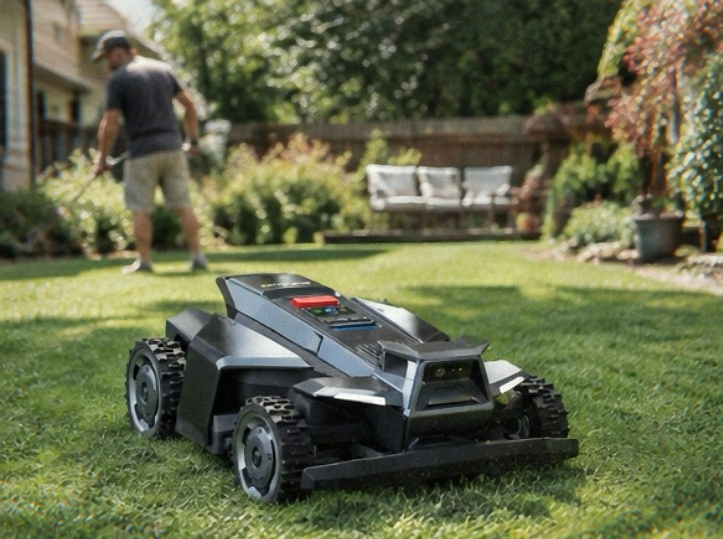
Segway is selling the Navimow X430 to people with the worst lawns they own — the back slope that eats push mowers, the drainage ditch, the half acre of grass that got away from them in July. It is a 63.7 lb tracked-looking machine with two 180 W drive motors, eccentric front wheels that steer like a forklift, and an ORV-tuned suspension rated for a 40° climb. The pitch is convincing. Whether your yard deserves it is a different calculation, and that calculation starts with some physics Segway put in the fine print.
Contents
- The Spec Sheet, Read Like an Engineer
- How 4WD at 84% Changes the Job
- What Zero-Turn Actually Costs Your Turf
- 17 Inches vs. One Acre: The Time Budget
- Xero-Turn, EFLS RTK and the Antenna Question
- The 63.7 lb Problem at the Dock
- Blades, Belts and the Parts You Will Replace
- Skip It If Your Yard Looks Like This
- Frequently Asked Questions
- The Honest Bottom Line
The Spec Sheet, Read Like an Engineer
| Spec | Figure | What it means in practice |
|---|---|---|
| Drive | 4WD, 2 × 180 W motors, ORV-tuned dual suspension | Real torque on wet grass; climbs 84% (40°) |
| Steering | Xero-Turn AWD, eccentric front wheels | Front wheels can turn independently of each other |
| Cutter | Dual discs, 12 blades, 17 in width | Two passes per 34 in of ground, not three |
| Cutting height | 0.75–4 in | Tall fescue is comfortable; a true scalp cut is not |
| Navigation | EFLS tri-frequency Network RTK + 360° vision + VIO | RTK is the reference, vision covers the dropouts |
| Obstacle AI | VisionFence, 200+ obstacle classes | Shrubs and toys, not fallen branches |
| Edge trim | EdgeSense, under 2 in margin | Better than most; still a string trimmer job |
| Charging | 224 W, 2.6 ft/s peak speed | Fast charge is the real efficiency story |
| Mapping | One-tap Auto Mapping, Antenna-Free, GeoSketch, 120 zones | No RTK pole to plant in the yard |
| Weight | 63.7 lb | You will not carry this up stairs without a plan |
The parts that matter are the ones Segway markets least: 224 W of charging input and a 2.6 ft/s top speed. On a machine this heavy with this much motor, cutting speed is not the bottleneck. Getting energy back into the pack is. That is why the X430’s daily acre claim holds together, and why a slower charger on the same chassis would not.
How 4WD at 84% Changes the Job
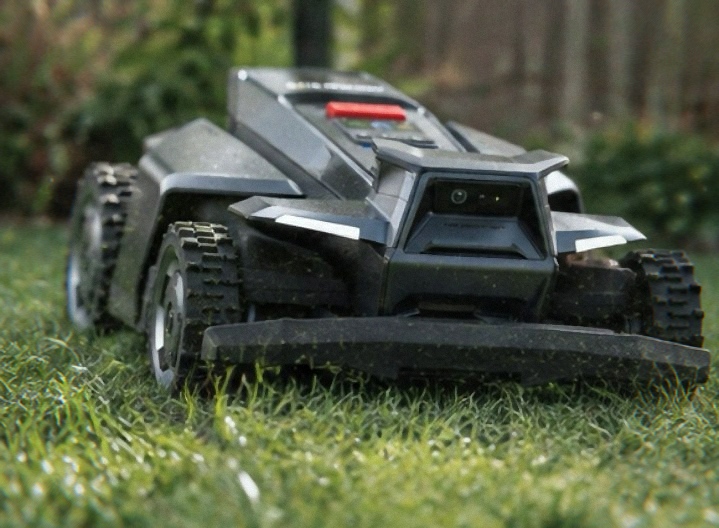
A 40° slope is not a hill, it’s a wall you can lean on. Most robotic mowers top out around 25–30% and start sliding sideways once the grass is wet, because they drive two wheels and hope for the best. The X430 drives four and puts suspension between the chassis and the ground, which is the difference between consistent blade height on uneven ground and a mower that scalps the crown of a bump and leaves the hollow untouched.
There is a cost hiding in that design. Four driven wheels plus a suspension assembly plus a 63.7 lb chassis means more unsprung mass and more places for grass clippings to pack in. Every one of those eccentric front-wheel housings is a small moving assembly with its own bearing surface, sitting six inches off wet ground, collecting grit. It is a wear item in disguise.
What 4WD buys you is not speed. It buys you the option of ignoring your slope. The half of the yard you currently leave for the riding mower in second gear becomes robot territory. If you do not have that slope, you are buying suspension and motors you will never stress, and paying for the weight every time the machine has to climb back to its dock.
What Zero-Turn Actually Costs Your Turf
The marketing line is “damage-free mowing.” The mechanism is more interesting than the claim. Conventional robot mowers with a rear steering axle pivot on their own footprint, and the rear wheel pivoting in place is what tears a turf divot. The X430’s eccentric front wheels turn independently, so the machine can rotate around a point that is not sitting on the grass underneath a loaded drive wheel.
That is a genuine fix for a real problem. It is not a permanent immunity pass. A 63.7 lb machine that turns in place 30 times a day on soft spring turf still leaves a signature, thinner and less spectacular than a gouged tire rut, but there. Where the zero-turn design pays off most is narrow corridors: a gate gap that a rear-steer mower would have to back out of, a strip between a fence and a hedge, a 40 in passage between beds. The X430 turns and leaves instead of reversing and hoping.
The geometry has a second consequence. With front-wheel steering, the cutting discs sit behind the steering axis, so the deck traces the front wheels slightly better than a rear-steer machine traces its path. That is exactly what makes EdgeSense’s under-2-inch margin achievable. Less than 2 in is about as good as an RTK-guided mower gets without a physical bumper against the edge — and in a yard with a low retaining wall or a curb, it is still enough gap to leave a strip of grass your string trimmer will find. Budget for that. The robot does the acre; you still walk the perimeter once a month.
17 Inches vs. One Acre: The Time Budget
One acre is 4,840 square yards. A 17 in deck with a practical 90% overlap efficiency covers roughly 1.3 square feet per foot of travel. At the 2.6 ft/s peak speed, that is a theoretical ceiling around 4,500 sq ft per hour — under perfect conditions, on flat ground, with no turns, no recharge, and dense grass that does not slow the dual 180 W discs.
Real numbers land well below that. Turning at the end of each pass, slowing for the obstacle layer, climbing back to a base station in the corner of the property, and the density of thick grass all eat into it. Treat one acre as a two-day job the first week and a rolling daily job once the grass is under control — and only if the base station sits somewhere central, not in the far corner behind the shed.
The charger is what saves this. 224 W into a machine this size is unusually aggressive for a robot mower, and it is the reason a mid-day recharge does not blow up the schedule. A mower charged at half that rate would need to idle most of the afternoon; the X430 goes back to work. This is the single spec I would point a skeptical buyer at, ahead of the slope rating, because it is the one that decides whether the thing finishes your yard or lives on the dock.
Xero-Turn, EFLS RTK and the Antenna Question
The X430’s navigation stack is RTK with a roof-level view of the sky, a 360° vision layer, and VIO — visual-inertial odometry — to fill the gaps when the correction signal degrades. EFLS uses three frequencies and, critically, two correction channels: home WiFi or 4G. That dual-path detail is what separates this generation of Navimow from first-gen RTK mowers that went blind the moment they turned the corner of a metal-sided building.
Signal quality is not a software setting, it is a physical placement problem. The base station needs a clear view of the sky and a few feet of clearance from the house wall. Put it tight against brick or under a metal awning and every downstream problem — drifting straight lines, phantom obstacle stops, refusal to dock — traces back to that one installation choice. The manual will tell you this. It will not tell you loudly enough to save you a wasted afternoon.
Obstacle detection uses AI vision classifying 200+ object types. Treat the number with suspicion. Vision classifiers are trained on recognizable shapes, so a lawn chair, a ball, a dog bowl, a garden hose reel: handled. A low branch that swings into the camera field, a pile of leaves over a paver edge, a black plastic drainage grate flush with the soil: not reliably. Those are the cases where an RTK mower will happily drive over an obstacle it never recognized as one. Clearing the lawn of anything under 3 in tall and under 5 lb is not optional maintenance, it’s the operating condition.
The 63.7 lb Problem at the Dock
Sixty-three pounds is not a lot until it is upside down in a flower bed, or half a wheel off a curb, or sitting in mud after a week of rain. There is no lift handle that makes this graceful. It is a two-hands-and-a-straight-back job, and if you have a mower stuck in a spot your back cannot tolerate, the robot has solved nothing — you have just automated the easy 95% and added a new failure mode for the last 5%.
The dock is the other blind spot. A 4WD mower rated for a 40° climb still needs to arrive at its charging contacts with enough alignment to seat. A base station on a flat pad is required, not recommended: a slight cross-slope under the dock and the machine will slide off its approach line at the last few feet, contact, fail, retry, and eventually park itself wherever the error boundary puts it. Build the pad flat and level, on a hard surface if you can, and put it somewhere the machine can approach along a straight line rather than backing into a corner. The dock is the part of this system people skip — it is also the part that generates the “it won’t dock” complaints.
Blades, Belts and the Parts You Will Replace
Twelve blades on two discs. That is a lot of cutting hardware sitting a couple of inches off the ground, in grass that is damp at 7 AM, on a machine weighing over sixty pounds. The blades take the abrasive load of soil and grit every pass; they dull faster on a sandy yard than a clay one, and a dull blade tears grass rather than cuts it, which shows up as a browning tip across the lawn a week later.
The motor wiring and the disc assemblies are the parts I would watch. A dual-disc deck running two 180 W motors in a chassis that is tilting, pitching, and climbing at 40° means constant flex at the connector and harness points. It’s the same class of failure you see on any suspension-equipped tool: the drivetrain is fine, the cabling going to it is what fatigues. Order replacement blades at the start, not after the first browning tips show up, and inspect the underside for packed clippings every couple of weeks in growing season — a caked deck changes the airflow under the discs, and cutting quality falls off before the blades are actually dull.
Skip It If Your Yard Looks Like This
Skip it if your yard is flat, simple, and under a quarter acre. You are buying 63.7 lb, four driven wheels, and an ORV suspension to drive in circles on a lawn a $900 GPS mower handles fine. The slope rating does not compound into anything on flat ground.
Skip it if the whole lawn is a single open rectangle with no obstacles. RTK plus vision is expensive insurance you will never claim. A LiDAR-only machine maps a clean rectangle in one pass and costs less.
Skip it if you will not build a flat dock pad, or you do not have a spot with a clear sky view a few feet from the wall. This system’s quality is downstream of those two installation decisions, and no amount of on-device AI compensates for bad ones.
Buy it if you are currently losing the back slope to a push mower every two weeks, and the alternative is either a landscaping contract or a second machine just for terrain. That is the case the X430 was engineered for, and the case where the dual 180 W motors, the eccentric front-wheel steering, and the fast charger all justify their weight.
If you’re still weighing terrain over everything else, the ECOVACS Goat A2000 LiDAR PRO is the alternative to read next — it solves the tree-shade problem the X430 solves with vision, but through a completely different sensor stack. And if you’re the type who values clean documentation and factory support over raw specs, the Honda Miimo remains the reference point for “boring and predictable” in this category.
Frequently Asked Questions
Does the Navimow X430 really handle an 84% slope? The traction system will climb it — 4WD with dual 180 W motors and an ORV suspension does that part. The variable is the surface. Dry grass on packed soil, yes. Wet clay, or a slope so steep the blade housing tilts enough to reduce effective cutting height, you’ll see ragged cuts at the top and bottom of the pitch. The slope rating is a traction claim, not a cut-quality claim.
Do I still need a perimeter wire? No wire, no RTK antenna pole to plant. Mapping is done by driving the boundary once in the app, then editing with GeoSketch. The catch: the base station placement matters as much as with an RTK-pole system, because EFLS still needs a clean sky view for its correction reference.
How long does an acre actually take? Plan on a full day plus a recharge for the first pass, then a rolling daily schedule once the lawn is under control. The 17 in deck is the constraint, not the speed. The 224 W charger is what makes a mid-day recharge tolerable rather than schedule-destroying.
Will it mow in the rain? Don’t. Wet grass packs the deck, dulls the blades faster, and the vision layer’s obstacle confidence drops with the light. Schedule it in the window after the dew burns off and before the afternoon storms.
Is the 2.8 in obstacle crossing height real? For a stick, a root, a paver edge standing proud of the soil: yes. For anything taller, the suspension lifts the front, then the rear discs either climb it or scrape it. Treat 2.8 in as a bump spec, not a “drive over anything” spec.
What is actually the weak point? The dock approach and the underside of the deck. A flat, level pad fixes the first; a monthly inspection and regular blade swaps fix the second. Everything on the chassis that wears is downstream of those two.
The Honest Bottom Line
The Navimow X430 is not a general-purpose robot mower. It is a slope machine with a fast charger attached, and Segway priced it accordingly — there is a reason it costs roughly what a decent riding mower does. Check the current price on Amazon before you commit, because the list price and the discount cycle on this model swing widely and the value case collapses fast at full retail.
If your property has a genuine terrain problem, this is one of the few machines that addresses it without adding an antenna or a perimeter trench three years of leaves will bury. If it does not, the same money buys a lighter mower with a slower charger and a perfectly good cut on flat ground — and you will never miss the 4WD.
One more thing worth doing: before you map anything, mow the perimeter strip by hand once and look at how much grass your string trimmer leaves behind. That number tells you more about whether this machine meets your standard than any spec sheet will.