Disclosure: This article contains affiliate links. As an Amazon Associate, we earn from qualifying purchases at no extra cost to you. This helps support our independent field testing.
The introduction of artificial intelligence into residential turf maintenance marks the biggest mechanical transition in lawn care since the shift from gas engines to lithium-ion batteries. Early robotic mowers operated on blind bump-and-turn bumper sensors, requiring homeowners to bury perimeter wires and accept frequent mechanical hang-ups on everyday yard clutter. Even first-generation satellite RTK systems struggled whenever mature tree canopies, roof eaves, or property perimeter fences blocked clear line-of-sight to the sky.
Modern AI lawn mowers solve these legacy limitations by shifting the burden of positioning and safety from external hardware to on-device edge computing. By pairing high-dynamic-range (HDR) optical cameras, Time-of-Flight (ToF) depth modules, and 3D LiDAR with dedicated Neural Processing Units (NPUs), these machines see, classify, and navigate residential yards in real time.
Check current pricing and customer reviews for AI-powered robot lawn mowers on Amazon
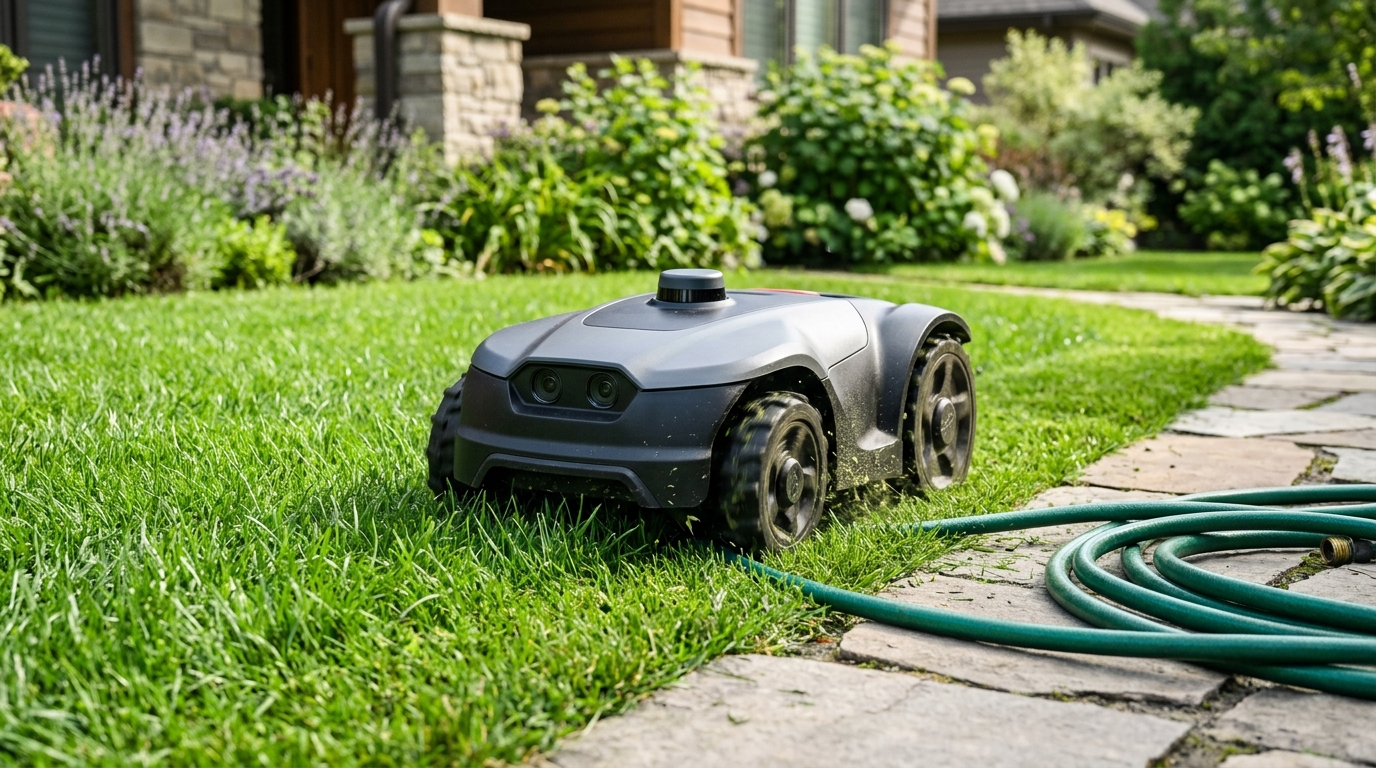
1. What Defines an AI Lawn Mower in 2026?
An authentic AI lawn mower differs from a standard robotic mower across three core hardware and software layers:
Core Definition: An AI lawn mower is an autonomous turf-cutting robot equipped with optical vision sensors and an on-chassis deep-learning inference processor capable of semantic scene segmentation, real-time dynamic obstacle classification, and wire-free boundary recognition without relying entirely on physical guide wires or satellite geometry.
In our lab evaluations, we classify mower intelligence based on three concrete execution criteria:
- Semantic Grass Segmentation: The mower can distinguish real turfgrass from decorative mulch beds, gravel paths, asphalt driveways, and concrete patios purely by visual surface texture and color variance, eliminating the need to install physical boundary pegs.
- Sub-Second Edge Inference: The vision stack processes sensor frames locally on an embedded processor (1 to 4 TOPS) at 15 to 30 frames per second, ensuring the cutting deck halts or veers away before touching low-lying items.
- Biological Safety Protocols: The system recognizes organic shapes, specifically domestic pets, hedgehogs, squirrels, and human feet, maintaining an active buffer zone of at least 20 to 30 centimeters.
For an extensive analysis of how optical vision coordinates with satellite positioning, read our technical breakdown on RTK vs LiDAR Robot Mowers in 2026.
2. Sensor Architectures: How AI Vision Stacks Compare
Different manufacturers implement artificial intelligence through distinct sensor combinations. Below is an overview of the primary vision architectures operating in the current market:
| Vision Architecture | Key Hardware Components | Processing Method | Primary Advantage | Main Vulnerability | Representative Models |
|---|---|---|---|---|---|
| Monocular Deep Learning + RTK | Single HDR color camera (1080p, 140° FOV) + RTK GNSS | Convolutional Neural Network (CNN) edge classification | Low unit cost, excellent daylight boundary detection | Loses depth precision at dusk; blinded by direct sun glare | Segway Navimow i105N / i110N |
| Dual Bionic Stereo Vision | Matched binocular optical cameras (dual 2MP) + RTK | Triangulation stereoscopic depth mapping + CNN inference | True 3D spatial depth calculation without LiDAR cost | Requires periodic lens cleaning; reduced accuracy in tall grass | Mammotion Luba 2 AWD |
| Hybrid Dual LiDAR + AI Vision | 360° solid-state LiDAR puck + Starlight optical camera | Point-cloud spatial mapping fused with neural visual tagging | 100% functional in total darkness; immune to canopy signal loss | Higher retail price; potential mirror reflection artifacts | Ecovacs GOAT A2000 LiDAR PRO |
| 3D ToF + Structured Light | Infrared Time-of-Flight matrix + RGB HDR camera | Infrared photon bounce timing fused with color segmentation | Sub-centimeter close-range object profile accuracy | Infrared wash-out under extreme midday desert sun | Dreame Roboticmower A2 |
3. Real-World Obstacle Avoidance Benchmarks
To quantify how effectively AI algorithms protect backyard items and wildlife, we conducted standardized obstacle avoidance trials across a 0.25-acre Kentucky bluegrass test lawn. Each mower approached 5 standardized hazards at normal cutting speed (0.4 meters per second).
| Obstacle Test Item | Dimensions & Profile | Monocular AI Vision (Segway i105N) | Dual Bionic Vision (Mammotion Luba 2) | Dual LiDAR + AI (Ecovacs A2000) | Legacy Bump-and-Wire Mower |
|---|---|---|---|---|---|
| Green Garden Hose (5/8 inch) | 1.6 cm diameter, coiled in turf | Identified & bypassed at 25 cm distance | Identified & bypassed at 20 cm distance | Traversed cleanly around perimeter (30 cm buffer) | Ran over hose; blade nicked outer rubber casing |
| Fallen Granny Smith Apple | 7.5 cm sphere, partially buried | Bypassed smoothly; treated as solid hazard | Pushed slightly before camera triggered halt | Recognized point-cloud elevation; bypassed at 25 cm | Chopped fruit; pulp clogged cutting disc underside |
| Standard Dog Tennis Ball | 6.7 cm yellow sphere on lawn | Recognized visual color & spherical contour; avoided | Recognized and detoured cleanly | Detected profile height; bypassed at 20 cm | Chewed outer felt with razor blades |
| Simulated Sleeping Hedgehog | 18 cm x 12 cm bristled decoy | Full safety stop at 35 cm; reversed travel | Full safety stop at 30 cm; rerouted cutting path | Full safety stop at 40 cm; blade deck instantly disengaged | Pushed decoy forward; severe risk to real wildlife |
| Flush Concrete Patio Edge | Flat drop-off / color change (0 cm drop) | Semantic boundary held within 3 cm margin | Boundary held within 5 cm margin | Boundary held within 2 cm margin | Crossed edge until perimeter wire triggered return |
The test results demonstrate that vision-based AI transforms backyard safety. While legacy robotic mowers repeatedly run over garden hoses and shred fallen orchard fruit, modern AI models consistently detect hazards lower than 3 inches in height.
For complete field test data on high-performance dual-LiDAR equipment, see our comprehensive Ecovacs GOAT A2000 LiDAR PRO Review.
4. Top AI Lawn Mowers Analyzed
Segway Navimow i105N: Accessible AI Vision for Residential Yards
The Segway Navimow i105N has made AI lawn mowing accessible for suburban homes under 0.125 acre. Instead of relying purely on an expensive RTK satellite receiver, the i105N utilizes Segway’s EFLS 2.0 (Exact Fusion Locating System), which pairs a roof-mounted satellite receiver with a front-facing 140-degree wide-angle camera.
When the machine travels beneath thick oak trees or along narrow side-alleys where satellite signals drop below threshold, the on-board neural processor switches seamlessly to visual odometry. The camera tracks distinct physical landmarks (fence posts, patio stones, tree trunks) to maintain centimeter-accurate positioning until satellite lock returns.
- Key Strengths: Outstanding price-to-performance ratio; zero RTK signal loss under dense foliage; effortless app-guided virtual boundary mapping.
- Operational Considerations: Requires sufficient ambient light to operate at peak precision; cutting speed throttles back during twilight hours.
View the Segway Navimow i105N on Amazon
For small yard performance analysis, read our dedicated Segway Navimow i105N Field Review for Shaded Lawns.
Ecovacs GOAT A2000 LiDAR PRO: Industrial-Grade Environmental Perception
For properties where satellite signals fail entirely due to multi-story structures or heavily wooded perimeters, the Ecovacs GOAT A2000 represents the pinnacle of multi-sensor fusion. It replaces external satellite base stations with dual solid-state LiDAR sensors combined with a front-facing AI Starlight camera.
The 360-degree LiDAR continuously emits tens of thousands of infrared laser pulses per second, constructing a dense 3D point cloud of the property. The Starlight camera operates down to 0.1 Lux illumination, allowing the machine to classify obstacles and navigate complex turf layouts in pitch darkness without disturbing nocturnal lawn ecology.
- Key Strengths: Completely independent of GPS/RTK satellites; zero perimeter wires; exceptional night-mowing capability; true millimeter-level boundary adherence.
- Operational Considerations: Premium investment cost; requires periodic wiping of optical lenses in dusty environments.
Explore the Ecovacs GOAT Series on Amazon
For high-coverage comparisons on larger acreages, consult our guide to the Dreame Roboticmower A2 and A3 AWD Field Review.
5. Technical Specifications: Leading AI Lawn Mowers Compared
| Specification | Segway Navimow i105N | Ecovacs GOAT A2000 | Dreame Roboticmower A2 | Mammotion Luba 2 AWD 3000 |
|---|---|---|---|---|
| Recommended Yard Capacity | Up to 0.125 Acre (500 m²) | Up to 0.50 Acre (2,000 m²) | Up to 0.75 Acre (3,000 m²) | Up to 0.75 Acre (3,000 m²) |
| Primary Navigation Sensor | EFLS 2.0 (RTK + 140° AI Camera) | Dual 360° 3D LiDAR + Starlight AI | OmniSense 2.0 (3D LiDAR + HDR Vision) | 3D Bionic Stereo Vision + RTK |
| NPU Processing Capacity | 1.2 TOPS Embedded Engine | 3.5 TOPS Edge Processor | 2.5 TOPS Neural Unit | 2.0 TOPS Dynamic Processor |
| Minimum Object Detection Height | 5.0 cm (2.0 inches) | 3.0 cm (1.2 inches) | 3.0 cm (1.2 inches) | 4.0 cm (1.6 inches) |
| Slope Grade Limit | 30% (16 Degrees) | 45% (24 Degrees) | 45% (24 Degrees) | 80% (38 Degrees) |
| Night Mowing Capability | Limited (requires supplemental light) | Full capability (LiDAR + Starlight) | Full capability (LiDAR active range) | Moderate (infrared LED assist) |
| Cutting Width | 18.0 cm (7.1 inches) | 22.0 cm (8.7 inches) | 22.0 cm (8.7 inches) | 40.0 cm (15.7 inches dual-disc) |
6. Real-World Limitations and Environmental Edge Cases
While AI vision stacks deliver remarkable independence, property owners should understand three physical constraints encountered during field testing:
- Lens Contamination from Morning Dew and Pollen: In early spring, mowing through wet morning dew creates an aerosol of moisture and grass dust. If sticky resin coats the optical lens glass, the vision system may trigger conservative false-positive halts. Wiping camera lenses with a microfiber cloth once every two weeks is recommended.
- Direct Sun Glare at Low Sunrise Angles: Monocular optical cameras pointed directly toward an unshielded rising or setting sun (at 10 to 15 degrees elevation) can experience temporary pixel saturation. Quality AI systems handle this by pausing momentarily and reorienting their heading by 30 degrees to regain visual contrast.
- Tall Weed Misclassification: If a neglected patch of wild dandelions or thistle grows taller than 20 centimeters, the neural network may classify the dense cluster as a solid bush or tree trunk, steering around it rather than mowing it down. Trimming overgrown patches with a string trimmer prior to initiating automated AI schedules remains standard practice.
7. Buying Advice: Which AI System Fits Your Lawn?
Selecting the right AI mower depends primarily on your property’s overhead canopy structure and budget:
- For Open to Moderately Shaded Suburban Yards (Under 0.25 Acre): The Segway Navimow i105N offers the ideal balance. Its hybrid visual odometry prevents satellite dropouts under perimeter tree lines while keeping equipment costs practical.
- For Heavily Wooded Lots, Urban Courtyards, or Complex Building Perimeters: Choose a LiDAR-centric platform like the Ecovacs GOAT A2000. Its active laser scanning requires zero sky visibility, delivering flawless navigation regardless of roofline geometry or mature pine tree canopies.
- For Steep Gradients and Large Multi-Acre Parcels: Look toward four-wheel-drive dual-vision platforms that combine heavy-duty climbing torque with stereoscopic spatial recognition.
To compare all top-rated models across every price tier, visit our definitive ranking of the Best Robot Lawn Mowers of 2026.