My aunt called me in May to ask whether she should “just hire the kid down the street again.” The kid down the street is 26, charges sixty bucks a mow, and has opinions about her sprinkler schedule. She hated him. Her lot is a small, L-shaped quarter acre with a shady strip behind the garage, and she’d already burned out on a boundary-wire mower back in 2023 — buried the wire on a Saturday, severed it with an edger on the following Saturday, swore off robots forever on the Sunday.
So when the WORX Landroid Vision Cloud WO7144 showed up at about a thousand bucks, wire-free, with a camera and cloud RTK, I did the reasonable thing. I bought one, told her I’d “test it first,” and ran it on her lawn for two weeks while she squinted at it through the kitchen window like it owed her money.
I wanted it to be mediocre. Cheaper wire-free mowers usually are. It mostly wasn’t, and I’m mildly annoyed about having to say nice things.
What this thing actually is
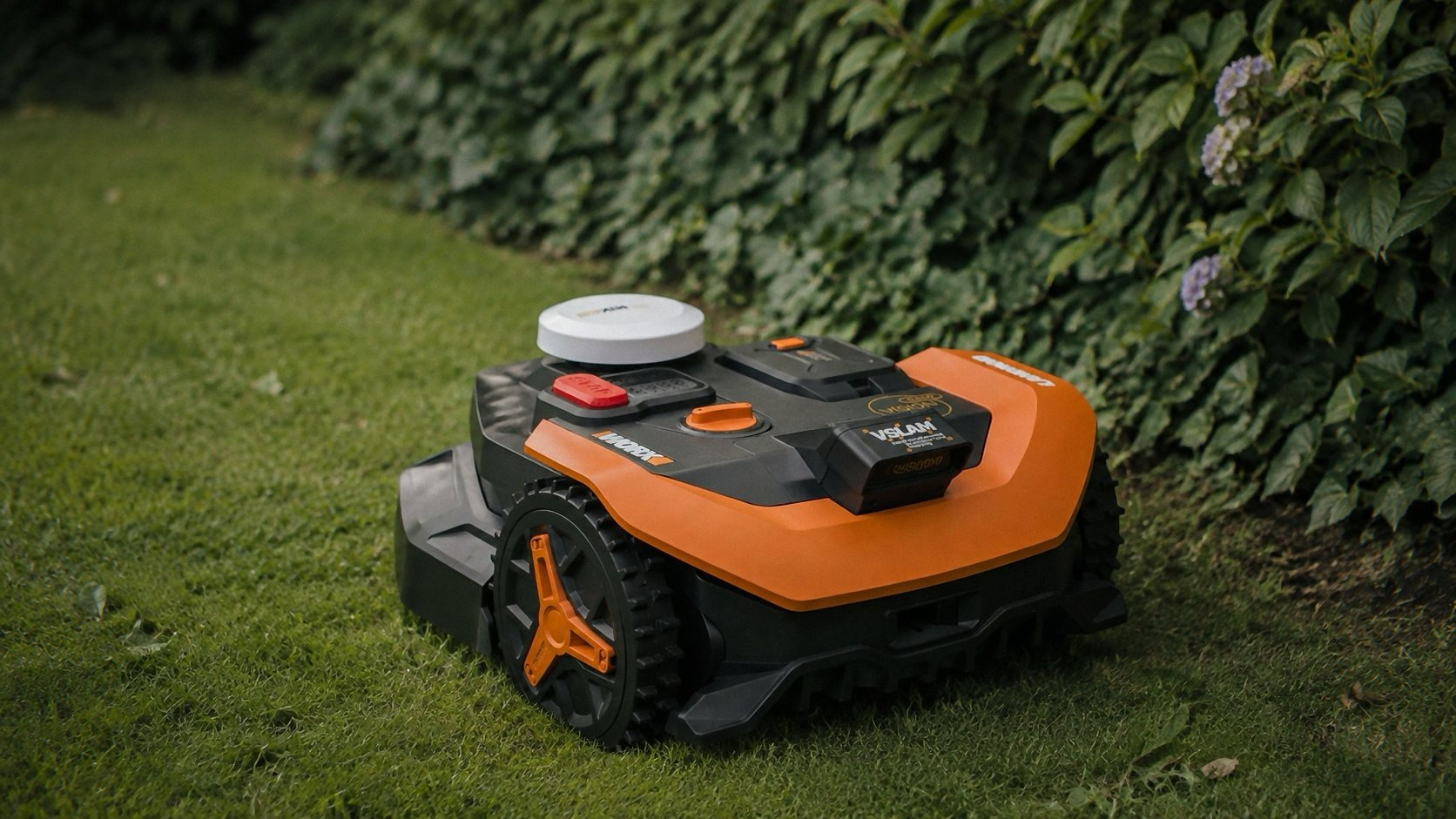
Quick orientation, because WORX names its products like license plates. The WO7144 is the smallest, cheapest member of the new Landroid Vision Cloud family — the wire-free lineup that ditches the boundary wire entirely. Quarter-acre capacity. RTK Cloud navigation plus a camera doing AI vision and V-SLAM. 8.7-inch cutting width, cutting height adjustable from about 1.6 to 3.5 inches, 30% slope rating, 80 minutes of runtime, 39.2 pounds. Two-wheel drive, and — this is the quirky part — little brushes mounted ahead of the drive wheels. Literally brushes. On a mower. More on those later.
If you remember the old wire-dependent Landroids, this is not that. I put the Landroid L WR155E through its paces a while back and came away respecting the cut but resenting the wire, the way you resent a talented employee who requires a daily pep talk. The Vision Cloud is WORX growing up.
Setup: the part where I waited to be disappointed See Today’s Deal on Amazon
Unboxing was uneventful in the best way. The mower comes out basically whole. Charging station, a handful of pegs, the wheel brushes, six spare blades. The body has this matte orange-black shell that feels thinner than the premium bots — there’s a slight flex if you press the top panel near the camera housing — but the wheels are chunky and the whole thing picks up one-handed without complaint. The handle has a rubberized grip that’s already attracting dust in a way I find personally offensive and cannot justify.
Here’s the thing about the RTK Cloud system: no antenna. I’ve complained at length in my RTK vs LiDAR piece about RTK mowers that demand you plant a reference station in your yard like you’re surveying for a railroad. WORX pulls the correction data from the cloud instead. The base station just needs power and 2.4 GHz Wi-Fi.
That last part matters more than the marketing lets on. 2.4 GHz only. Her router sits in the front bedroom; the dock lives behind the garage. First mapping attempt, the connection dropped twice and the app got sulky. I stuck a cheap Wi-Fi extender in the garage outlet — twenty-five bucks, five minutes — and it hasn’t dropped since. Budget for that if your router is more than one wall away from the dock. Consider it a hidden $25 line item.
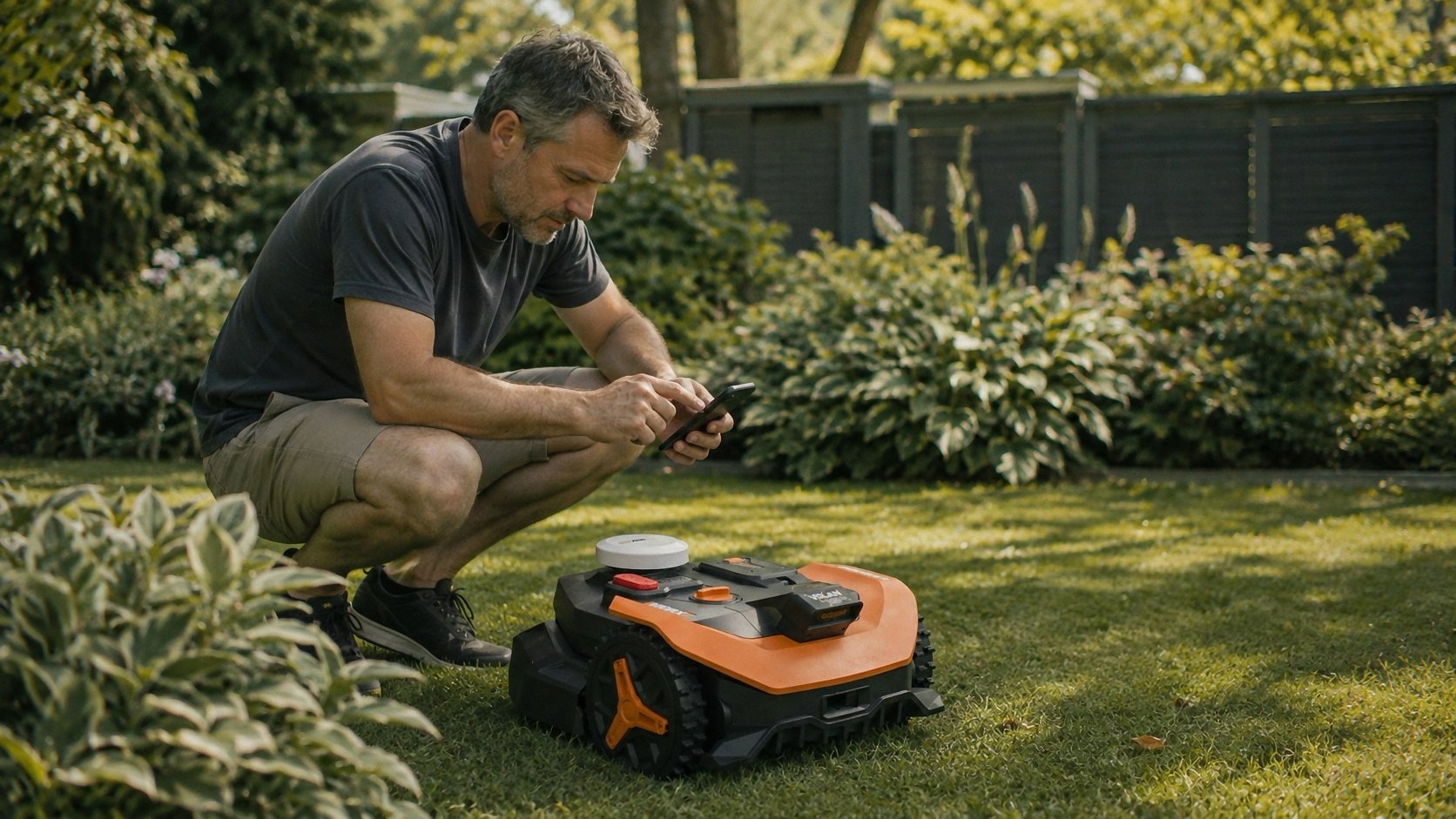
Mapping itself was eerily calm. The camera reads the lawn’s shape and boundaries — grass meeting mulch, grass meeting pavement, grass meeting fence — and builds the map as it goes. I walked behind it with the app open like a parent following a toddler. The L-shape, the narrow corridor behind the garage, the ring around her sad little birdbath: mapped in one pass, maybe forty minutes. No wire. No pegs beyond the dock. My aunt watched the whole thing and said “hm,” which from her is a standing ovation.
Two weeks of actual mowing
The quarter-acre claim is honest. Her lot finished in a single charge most sessions, running a little over an hour. The checkerboard pattern leaves straight, even rows — proper stripes, the kind that make a small yard look maintained instead of merely tolerated.
The obstacle avoidance is the part I keep telling people about. Neural network, ten trillion operations per second, whatever — what it means is the mower sees a garden hose and goes around it instead of eating it and sending you a notification of its failure. It avoided a rake, three pinecones the size of grenades, a football the neighbor kids keep losing over the fence, and — this is the detail that sold my aunt — her neighbor’s cat, which it stopped for, waited out, and then detoured around with what I can only describe as courtesy. There’s a faint double-beep when it decides to reroute around something. You start to recognize the sound. It’s the sound of not having to go outside.
Shade performance deserves its own sentence because shade is where GPS-based bots go to die. The strip behind her garage sits under a crabapple and gets maybe ninety minutes of direct sun. The camera-plus-V-SLAM fusion handled it without a single lost-position tantrum in two weeks. The Segway Navimow i105N is the obvious rival for exactly this kind of small, tree-adjacent yard, and I gave it a fair shake too — it’s a fine machine, but the WORX undercuts it on price and the cut-to-edge is genuinely better. If you’re torn between bigger names, my Segway X430 vs Ecovacs A3000 comparison covers the higher-end fight; the WO7144 isn’t playing in that bracket and doesn’t pretend to.
If you grab one through the links here, I might get a small cut — costs you nothing extra and keeps the lights on.
The brushes. Yes, really.
I mocked these when I opened the box. Two stiff-bristled brushes that clip on ahead of the drive wheels, sweeping clippings and grit out of the tire path as it drives. It sounded like a solution to a problem nobody has.
Then came the damp week. Morning dew, one light rain, the kind of conditions where two-wheel-drive mowers start spinning their wheels and leaving muddy crop circles of shame. The WO7144’s tires stayed clean. Genuinely clean — I’d walk out and the treads looked freshly wiped. Traction held on the gentle slope by her driveway even with wet grass. It’s a dumb, simple, mechanical fix and it works, and I’ve decided to stop being mad about that.
Wheel brushes. What a world. The Navimow X430 handles wet slopes with fancier engineering and a fancier invoice, so maybe brushes are the budget answer to a premium problem.
Cut-to-edge, honestly assessed
WORX claims the Vision AI reads boundary types and cuts right up to edges. On the driveway and the paved walkway — where grass meets a hard, rideable surface — it’s excellent. The mower rolls a wheel over the edge and trims flush. Zero trimming needed there.
Along the fence and the raised bed borders, it’s good, not magic. It gets closer than any small mower I’ve tested this year, but you’ll still want a string trimmer pass every two or three weeks on fixed borders. WORX’s bigger 4WD sibling has a “Cut-to-Zero” offset blade for this; the WO7144 doesn’t. That’s the tax you pay at this price, and honestly, reducing edging work by 80% for a grand is a trade I’ll sign.
The downsides, because I haven’t gone soft
It’s a quarter-acre machine, full stop. The 80-minute runtime is fine for its rated size, but there’s no headroom for ambition. If your lot is at the upper end of a quarter acre, or you’re hoping it’ll also do the neighbor’s side, buy up a class. Mowers run at their limit age like dogs in a hurry.
Only two drive wheels. 30% slope rating is real but it’s a ceiling, not a suggestion. Her yard is mostly flat with one mild grade, perfect. If your yard has genuine hills, this is the wrong robot and you already know it.
The app nags. Firmware update banners, zone reminders, a cheerful little notification when it finishes mowing that I cannot figure out how to mute. I’ve looked twice. I’m a person who reviews these things and the setting eludes me. It may not exist. Send help.
No anti-theft GPS on this trim. The pricier Vision Cloud models get Find My Landroid with cellular tracking. This one has a PIN and an alarm. A loud alarm, sure, but an alarm is a hope, not a plan. Keep it in a fenced yard or bring it in at night if your neighborhood has opinions about unattended electronics.
Camera on overcast evenings. Once, on a properly gloomy dusk, it paused mid-lawn for about a minute like it was thinking things over, then resumed. Vision systems need light. It schedules fine in daylight; just don’t expect midnight heroics.
So who is this for See Today’s Deal on Amazon
Small yard. Flat-ish. Some trees, some shade, some borders. A person who got burned by a boundary wire and wants out of the wire business without spending two grand. That’s a huge slice of actual American lawns, and until now that slice got the leftovers — last year’s tech at this year’s prices.
The WO7144 is the first budget wire-free mower I’ve tested where I didn’t spend week two making excuses for it. It mows on schedule, it sees the cat, it keeps its wheels clean with a pair of brushes that cost pennies, and it costs less than the kid down the street charges for a season.
My aunt kept it. She paid me back in full plus twelve dollars “for gas,” which is her way of saying she likes something without having to say it. The neighbor kid has been reassigned to raking, apparently. He’s fine. He has opinions about that too.
It’s sitting on the charger behind her garage right now, blinking its little green light, scheduled for Tuesday and Friday mornings forever. She hasn’t touched the app since June. That’s the whole review, really — the most persuasive thing a robot mower can do is make itself boring, and this one is beautifully, aggressively boring.
The crabapple drops fruit in fall, though. I’ll be back to see how the camera feels about that.