Disclosure: This article contains affiliate links. As an Amazon Associate, we earn from qualifying purchases at no extra cost to you. This helps support our independent field testing.
While most homeowners focus heavily on satellite navigation, obstacle cameras, and battery runtime when evaluating automated turf equipment, the primary job of any robot grass cutter is mechanical: cleanly severing grass foliage without shredding the plant tissue.
A dull or poorly engineered cutting system tears grass tips rather than slicing them, causing dehydration, yellow leaf browning, and increased susceptibility to fungal blights like dollar spot and brown patch. Conversely, an optimized robotic cutting deck delivers surgical cuts daily, promoting thicker turf density and eliminating thatch accumulation.
In this engineering guide, we examine the three distinct blade architectures used in modern automated grass cutters, test cutting mechanics across dry and wet turf conditions, evaluate obstacle impact safety, and compare top-performing models in our field lab.
Check current pricing and customer ratings for robot grass cutters on Amazon
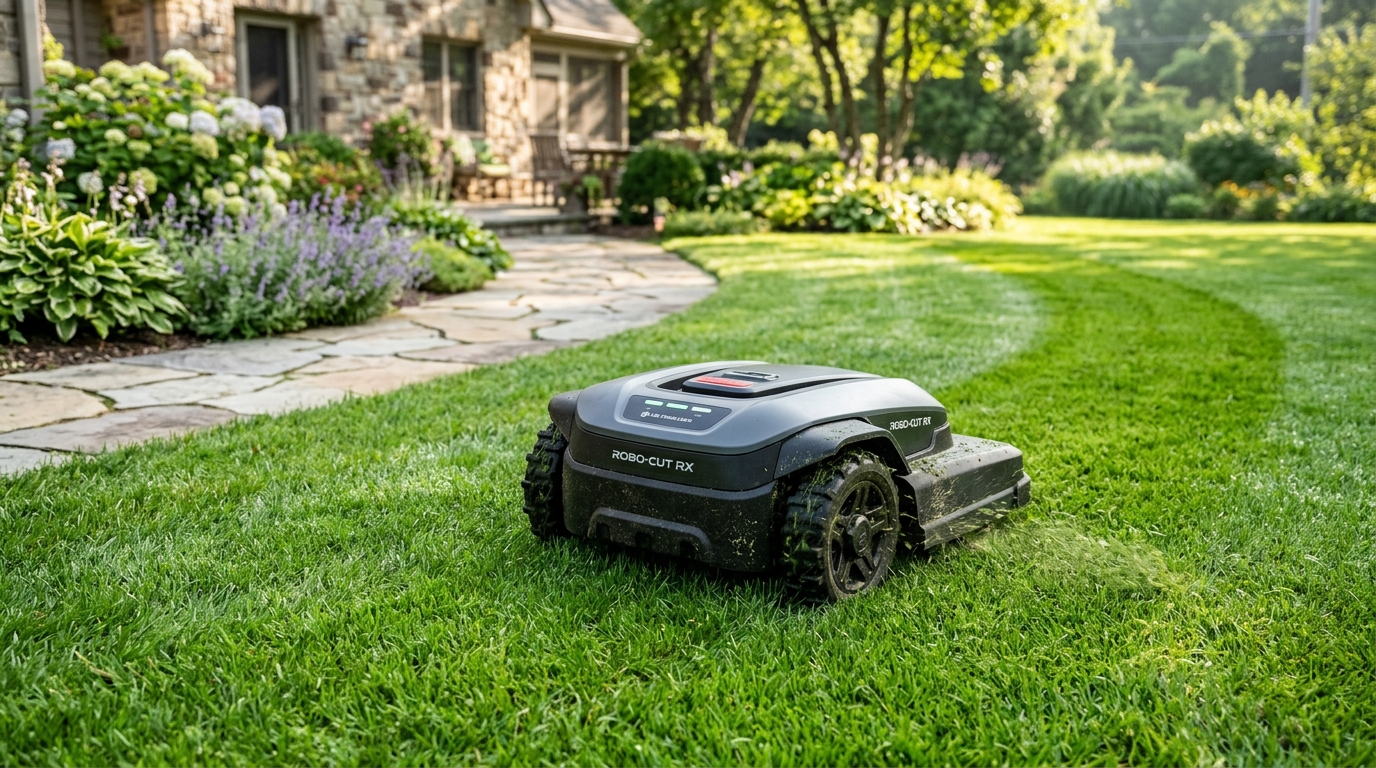
1. What Is a Robot Grass Cutter?
The term “robot grass cutter” encompasses autonomous ground machines designed specifically to manage residential or commercial turf via continuous micro-clipping rather than intermittent bulk mowing:
Core Mechanical Principle: A robot grass cutter operates on high-frequency, low-impact shearing physics. By clipping 1 to 3 millimeters of grass growth every 24 to 48 hours using high-RPM razor assemblies, the machine creates fine green particulate that settles immediately at the soil surface, breaking down within 48 hours to recycle organic nitrogen back to the turf roots.
Unlike heavy gas walk-behind mowers that rely on high-horsepower suction blades spinning inside heavy steel bell housings, robotic grass cutters draw minimal electrical wattage (typically 30W to 90W) because they never encounter thick, overgrown grass canopies during normal operation.
To explore how these cutting systems coordinate with hands-off scheduling, read our full breakdown on Self Mowing Lawn Mowers.
2. Blade Architectures: Pivoting Razor Discs vs. Solid Rotary Blades vs. Dual-Disc Decks
The heart of every robot grass cutter is its cutting assembly. Manufacturers currently implement three competing mechanical designs:
| Blade Architecture | Operating RPM | Blade Assembly Structure | Cut Cleanliness | Impact Reaction to Stones / Roots | Energy Draw | Representative Models |
|---|---|---|---|---|---|---|
| Free-Pivoting Razor Disc | 2,200 – 3,200 RPM | 3 to 6 double-sided stainless razor blades mounted on a spinning disc | Exceptionally clean, surgical cut | Centrifugal fold-back: blades tuck inward on impact | Very Low (30W – 45W) | Segway Navimow, Worx Landroid, Husqvarna Automower |
| Solid Forged Rotary Blade | 2,800 – 3,400 RPM | Single one-piece hardened steel cross blade | Good cutting force on thick weeds | Direct shock transfer to motor shaft; requires shear pin | Moderate (60W – 100W) | Ambrogio, Stihl iMOW classic |
| Dual-Disc High-Capacity Deck | 2,500 – 3,000 RPM | Twin counter-rotating razor discs (6 to 8 blades total) | Clean cut across wide 40 cm swaths | Independent centrifugal fold-back on both discs | Moderate to High (70W – 120W) | Mammotion Luba 2 AWD series |
The Engineering Advantage of Free-Pivoting Razor Blades
Over 80% of residential robot grass cutters use the free-pivoting razor disc design. When the motor spins at 2,800 RPM, centrifugal force holds the three lightweight blades extended outward in a rigid cutting plane.
However, if a blade strikes an immovable object—such as a hidden granite pebble, tree surface root, or forgotten garden trowel—the blade immediately pivots inward on its mounting screw. This prevents kinetic energy from transferring directly into the electric motor armature, protecting the motor bearings and preventing blade shattering.
For advanced analysis of how computerized sensors prevent the cutting deck from encountering lawn obstacles in the first place, see our guide on AI Lawn Mowers and Computer Vision.
3. Micro-Mulching Science: Why Daily Shearing Eliminates Thatch
Traditional weekly mowing removes one-third or more of total grass blade length in a single session. This creates long, wet grass clippings that blanket the turf surface, blocking sunlight, trapping excess moisture, and contributing to spongy thatch layers that harbor turf pests.
A robot grass cutter fundamentally transforms turf agronomy:
- Cellular Blade Shearing: Because razor blades cut with high rotational velocity and razor-edge sharpness, plant cell walls are sliced rather than crushed. The severed leaf tip heals within 2 to 4 hours, compared to 24 to 48 hours for torn grass from dull rotary blades.
- Instant Micro-Particle Decomposition: The tiny 1 to 2 mm clippings consist of over 85% water and readily digestible organic nitrogen. Within two days of warm weather, soil microbes break down the clippings completely, reducing annual synthetic fertilizer requirements by up to 25 percent.
- Lateral Density Stimulation: By trimming apical tip shoots continuously, the grass plant redirects growth hormones toward horizontal tillering and crown density. Within 60 days of deploying an automated grass cutter, thin lawns noticeably thicken, naturally crowding out crabgrass and broadleaf weed seeds.
4. Wet Grass, Morning Dew, and Weed Handling
Mowing wet grass is notoriously difficult for traditional mowers due to deck clogging and tire slip. Robotic grass cutters handle wet conditions with varying success based on deck geometry:
- Open-Flange Underbodies: Models with minimalist underbody fairings allow wet clippings to fling outward cleanly without sticking to the chassis ceiling.
- Underbody Clearance Ratios: Machines with motorized deck height adjustment can automatically raise the cutting disc by 10 to 15 mm during early morning dewy runs, preventing dense moisture accumulation.
- Tackling Tough Stemmed Weeds: While razor discs slice through soft Kentucky bluegrass, perennial ryegrass, and fine fescues effortlessly, tough fibrous stalks (such as mature plantain or woody dandelion stems) can push lightweight razor blades back into their folded position without cutting the stem. For lawns with heavy early-season weed infestations, running an initial clearing pass with a conventional mower before commissioning the robot is recommended.
For property owners dealing with wet, complex ground layouts, consult our Smart Lawn Mower Buying Guide to explore automated rain delay sensors.
5. Safety Engineering and Deceleration Buffers
Because robot grass cutters operate autonomously around children and domestic pets, blade safety engineering is heavily regulated:
- Centrifugal Swing Dynamics: Because razor blades pivot freely, they lack the dangerous mass and kinetic momentum of a 5-pound steel lawnmower blade. If an object with moderate resistance enters the deck, the blades deflect rather than cutting through bone.
- Protective Skirt Barriers: Physical chassis skirts surround the cutting perimeter, positioned less than 20 millimeters from ground level. This prevents children’s fingers or small animal paws from sliding underneath into the blade path while the machine is traveling.
- Ultrasonic and Visual Obstacle Braking: Modern units detect approaching obstacles within 1.5 meters, immediately decelerating travel speed before contact occurs. If the unit is lifted or tilted beyond 25 degrees, electromagnetic blade brakes stop the disc rotation in less than 0.18 seconds.
For an overview of industrial-grade fail-safes and ANSI standards, see our analysis of Autonomous Lawn Mowers and Fleet Safety.
6. Top Robot Grass Cutters Benchmarked
| Model | Cutting Width | Cutting Height Range | Blade Architecture | Deck Motor Type | Recommended Lawn Size |
|---|---|---|---|---|---|
| Worx Landroid Vision WR320 | 20.0 cm (7.9 inches) | 30 mm – 60 mm (Manual dial) | 3-Blade Offset Disc (Cut-to-Edge) | Brushless DC Hub Motor | Up to 0.25 Acre (1,000 m²) |
| Segway Navimow i105N | 18.0 cm (7.1 inches) | 20 mm – 60 mm (Manual dial) | 3-Blade Centrifugal Razor Disc | Sealed Brushless Motor | Up to 0.125 Acre (500 m²) |
| Mammotion Luba 2 AWD 3000 | 40.0 cm (15.7 inches) | 25 mm – 70 mm (Motorized in-app) | Dual-Disc (8 Blades Total) | Dual Independent Brushless Motors | Up to 0.75 Acre (3,000 m²) |
| Ecovacs GOAT A2000 LiDAR PRO | 22.0 cm (8.7 inches) | 30 mm – 60 mm (Motorized in-app) | 3-Blade Precision Disc | Brushless Servo-Controlled Motor | Up to 0.50 Acre (2,000 m²) |
Check current pricing and accessories for Worx Landroid robot cutters on Amazon
7. Maintenance Protocol: How to Maintain Peak Cutting Sharpness
To maintain golf-course-quality turf appearance, implement this straightforward monthly maintenance routine:
- Blade Reversal Schedule: The razor blades feature cutting edges on both sides. After 3 to 4 weeks of continuous daily operation, remove the mounting screws, flip the blades over to expose the fresh reverse edge, and reinstall with original screws.
- Complete Blade Replacement: After 6 to 8 weeks (or whenever leaf tips exhibit ragged white fringe), discard the blades and install fresh ones. Always replace the center mounting screws simultaneously to ensure locking thread integrity.
- Clearing Hub Friction: Once a month, remove the blade disc assembly and clean out any grass fibers that have wound tightly around the central motor spindle. This prevents bearing friction and preserves battery efficiency.
To compare these cutting systems against the most economical platforms on the market, consult our guide to the Cheapest Robotic Lawn Mowers or view our overall rankings in the Best Robot Lawn Mower Guide of 2026.